5. Refugees in London: heimweh (homesickness) and community
Mary Ward House, Tavistock Place.
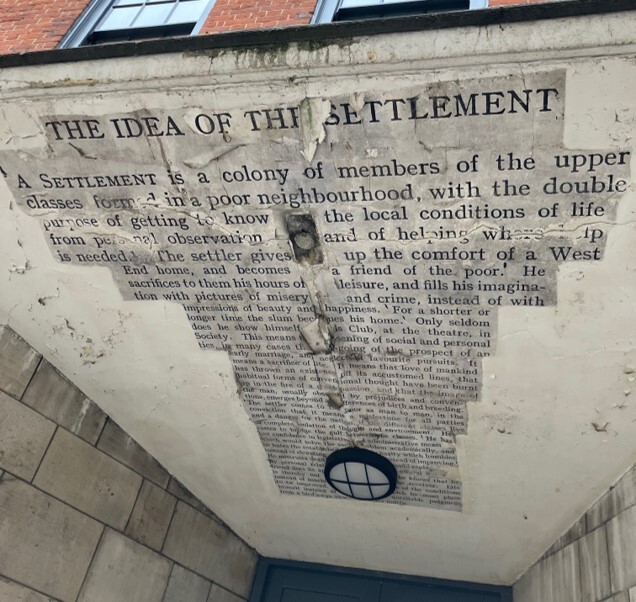
Originally named Passmore Edwards Settlement, after the benefactor who funded the building, this Settlement House was operated by Mary Ward (a social activist, who also wrote novels under her pen name Mrs Humphrey Ward). Above the side entrance of the building is this description of the Settlement Movement and what a Settlement was.
Though many people wanted - and needed - to leave Nazi-held territories, life as an emigrant was very hard. Archival materials demonstrate the loneliness of these exiles and family correspondence expresses how challenging and disorienting the experience was for dispersed family members.
It was incredibly important for refugees to have places to meet up, ideally with a café or restaurant serving home-cooked food and good coffee. There were several places where refugees could meet in Bloomsbury, one of which was the Mary Ward Settlement.
Established in the late 19th century, Settlement Houses offered social services to the urban poor and campaigned for social justice. And in the 1930s they offered a space for refugee groups to meet. The Mary Ward Settlement regularly hosted a discussion group ‘Das kommende Österreich’, formed in June 1939. The flyer below advertises some of the upcoming debates and invites Austrian exiles to bring their friends and aquaintances.
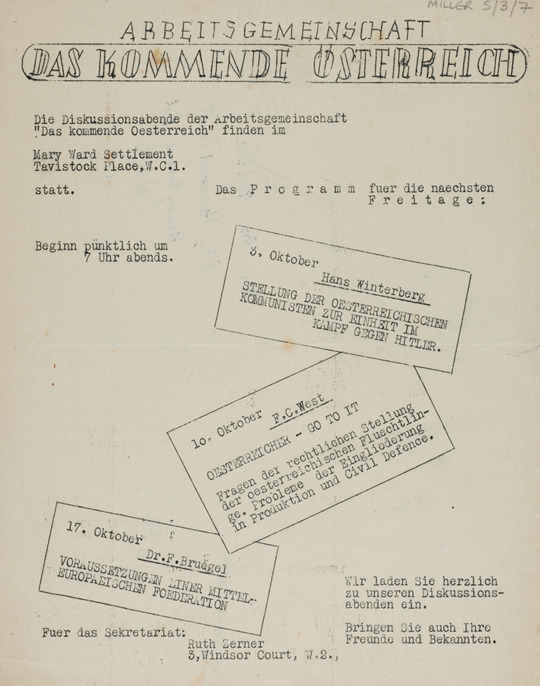
Flyer produced by the Austrian Group: Das Kommende Oesterreich (The Coming Austria)
Senate House Library, Martin Miller and Hannah Norbert-Miller Papers, Miller/5/3/7
Some of the subjects the group debated in the autumn of 1941 were:
- the position of the Austrian Communists with regard to unity with other exile political groups, especially the socialists, in the fight against Hitler;
- the legal position of Austrian refugees who, since the Anschluss in March 1938 were considered by the British to be German. Thus, as enemy aliens they had been interned and had difficulties contributing to the war effort.
The post-war fate of Austria was undecided until the Moscow Declaration in Nov 1943. 1941 white paper by Foreign Office still gave four options for postwar Austria: independence, remaining part of Germany, part of a Donau confederation, divided up between other countries. Consequently Austrians spent a lot of time and effort differentiating themselves from the Germans, and lobbying for an independent Austria.
Other supportive communities
At 3 Regents Square, the exiled journalist and bibliophile Fritz Gross ran a lending library. As he had been able to leave Germany very early, in 1934, he was able to bring with him his extensive library. Once established in Bloomsbury, Gross obtained a licence to run a lending library from the basement flat in Regents Square. The Library served as a meeting place and lecture room and was frequented by many exiles including Robert Neumann. A regular visitor and friend described the library:
Another friend (Hans Flesch-Brunning) remembers the library as chaotic and Fritz Gross as unusually kind. This probably made it an attractive place for the likes of the poet Erich Fried, and his friend Hans Schmeier, who were, at the time, teenagers who had come over on the kindertransport.
Gross wasn’t the only one organising lectures in Bloomsbury. In Museum Street there was an international bookshop run by Hans Preiss, which held lectures and readings, which Gross attended. And of course the famous reading room in the British Library – incidentally created by an Italian refugee who was the Keeper-of-the-Books at the time – was a popular place to work and meet.
Advice given to the English by the Welfare Department of the Central Office for Refugees about what they could do to help, often included simply ‘being friendly’:
Hans Schmeier
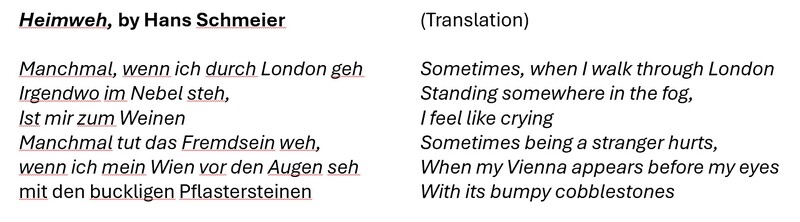
Unfortunately, supportive communities were not always enough to sustain exiles. In October 1943, Hans Schmeier died by suicide. His poem below expresses the homesickness he experienced as a refugee.
We cross the road and walk past Tavistock Square again. To reach our next stop we turn left down Bedford Way. Follow the Walk