Items
Subject is exactly
Women's rights
-
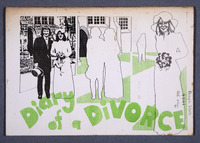 Diary of a Divorce Manchester’s Commonword stemmed from an oral history project, beginning in 1977 as the Commonword Workshop. The groups developed to include one focussing on women’s writing. This pamphlet was written and illustrated by Wendy Whitfield, who also worked at Commonword. Designed to reflect a calendar, the pamphlet depicts the disintegration of a marriage from the woman’s point of view, against a backdrop of left-wing political activism.
-
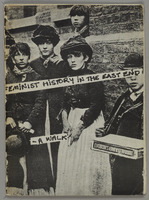 Feminist History in the East End: A Walk Published in 1979 by the feminist collective Rights of Women, 'Feminist History in the East End: A Walk' by Clare Manifold is both guidebook and manifesto. It maps a walking route through London’s East End, highlighting sites connected to women’s activism, labour struggles, and political organising. Blending history with lived geography, the booklet invited readers to encounter the city as a landscape of resistance and memory. Illustrated with photographs and portraits, it situates feminism within local histories of poverty, migration, and solidarity. More than a guide, it reflects late twentieth-century feminist efforts to reclaim women’s voices in public space.
-
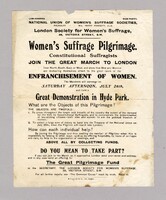 Invitation to a Social Gathering of the WSPU This flyer, issued by the National Union of Women’s Suffrage Societies (NUWSS), advertises the Women’s Suffrage Pilgrimage of July 26th, 1913. Organised by constitutional suffragists under the leadership of Mrs. Henry Fawcett, the march brought women from across England and Wales to London, converging in Hyde Park for a mass demonstration. Unlike the militant tactics of the suffragettes, the NUWSS emphasised law-abiding, peaceful protest to prove widespread public support for women’s enfranchisement. The flyer calls for participation, hospitality, and crucially funds, embodying the collective effort and determination behind the campaign for political equality.
-
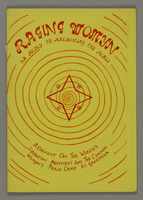 Raging Womyn: In Reply to Breaching the Peace Jean Freer’s pamphlet was a direct reply to the criticism's of the women’s peace movement in the 1983 publication 'Breaching the Peace'. She published it from the Greenham Common camp the following year. Freer rejected what she saw as the radical feminists’ isolationist approach to women’s liberation, arguing that the openness and mutual support fostered at Greenham had been empowering for women.
-
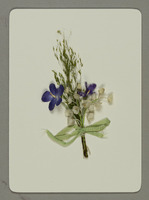 Silk Suffragette Buttonhole This silk Suffragette buttonhole, made around 1914, was designed to be worn in public as a sign of support for women’s voting rights. Small but striking, it turned clothing into a political statement. Like many suffrage objects, it combined elegance with activism, making protest visible in everyday life.
-
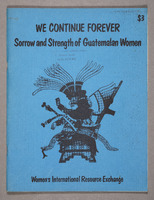 We Continue Forever: Sorrow and Strength of Guatemalan Women International exchange is at the heart of this pamphlet, which was published in New York City but contains the voices of Guatemalan women. The Women’s International Resource Exchange Service (WIRE) was founded by US feminists to publish global writing. A detailed consideration of this pamphlet and its role as a tool for resilience, written by Senate House Library librarian Julio Cazzasa, is available to read online.
-
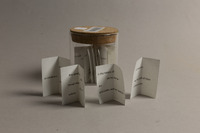 Who Finds Cells Created in response to Senate House Library’s 2018 ‘Rights For Women’ exhibition, this work is entirely without a spine, consisting instead of 18 small, folded slips of paper containing poetic text. The papers are housed within a glass jar, stopped with a cork. This format reflects the experience of viewing printed texts on display through the glass of an exhibition case.