-
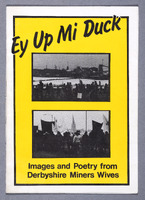 Ey Up Mi Duck: Images and Poetry From Derbyshire Miners Wives
 Created by the Derbyshire Women’s Action Group during the miners’ strike, this booklet combines poetry and images from miners’ wives. It highlights women’s voices in community struggle, capturing resilience, solidarity, and the social impact of industrial conflict in Derbyshire.
-
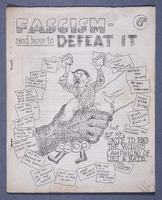 Fascism and How to Defeat It
 In 1959, fascist Oswald Mosley stood for election in Kensington North. Communist Party of Great Britain member and 'Daily Worker' writer Kathleen Mary ‘Kay’ Beauchamp wrote this rapid response. Beauchamp informs a post-war generation about Mosley’s history of fascist organising and suggests means of countering it through communism. The pamphlet’s simple design of loose pages stapled together reflects the urgency of the situation.
-
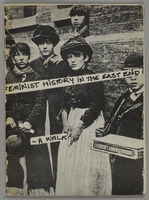 Feminist History in the East End: A Walk
 Published in 1979 by the feminist collective Rights of Women, 'Feminist History in the East End: A Walk' by Clare Manifold is both guidebook and manifesto. It maps a walking route through London’s East End, highlighting sites connected to women’s activism, labour struggles, and political organising. Blending history with lived geography, the booklet invited readers to encounter the city as a landscape of resistance and memory. Illustrated with photographs and portraits, it situates feminism within local histories of poverty, migration, and solidarity. More than a guide, it reflects late twentieth-century feminist efforts to reclaim women’s voices in public space.
-
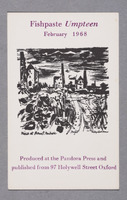 Fishpaste: Postcard Review of Art and Letters
 Printed on postcards (or postcard sized paper) which fitted in a table top Adana printing press, this ‘review of art and letters’ ran for two years on a monthly schedule. Printed at the Pandora Press by Rigby Graham, Toni Savage and Peter Hoy, each postcard contained a poem on one side and an illustration, usually by Rigby Graham, on the other. The title 'Fishpaste' was chosen as the contents of each issue were a surprise.
-
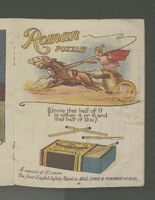 Fun Amongst the Matches
 As advances in technology made colour printing less costly, advertising and promotional ephemera in the form of leaflets, pamphlets, and flyers became increasingly common. The British match manufacturer Bryant and May produced this pamphlet in various versions in the early 20th century, using the popular pastimes of parlour puzzles and tricks to promote their match products as props.
-
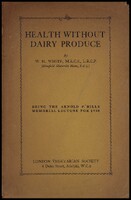 Health Without Dairy Produce
 W. H. White was a doctor who advocated vegan diets from infancy, promoting his views through lectures, recipe books, and the maternity homes he managed. This 1938 pamphlet, prompted by the craze for “milk bars,” extols the benefits of a dairy‑free diet and includes various testimonials. White’s views were far from mainstream and milk in particular remained a staple of dietary recommendations.
-
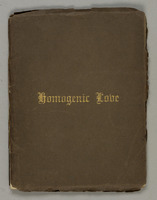 Homogenic Love, and Its Place in a Free Society
 Socialist Edward Carpenter used his writing to advocate for new ways of living. This appeal for gay and lesbian equality was published in 1894, only the year before Oscar Wilde was imprisoned for his homosexuality. Carpenter had hoped this essay would be published as part of a collection but the text was deemed dangerous and was published as a pamphlet for private circulation only.
-
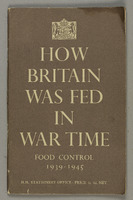 How Britain Was Fed in War Time: Food Control, 1939-1945
 Governments and institutions have long been prolific producers of spineless material: published acts, policy and research papers, reports, and leaflets offering information and advice. Such publications were an important means of spreading information and propaganda for the UK government during the Second World War. The Ministry of Food produced numerous pamphlets and leaflets related to food control and rationing. This particular pamphlet, published in 1946, provided an account of how food resources were mobilised during the war, including extensive statistical data and information that had been suppressed in the preceding five years.
-
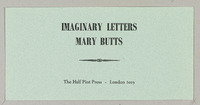 Imaginary Letters
 This work is a reimagining of Mary Butts’s 1928 modernist novella 'Imaginary Letters', which centres on eight letters. Half Pint Press’s edition interweaves content and form - each of the novella’s letters is printed as such, using different paper stocks, styles and layouts and enclosed in an envelope. The letters are tied with ribbon, as if the reader has stumbled across a stash of secret correspondence.
-
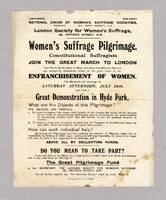 Invitation to a Social Gathering of the WSPU
 This flyer, issued by the National Union of Women’s Suffrage Societies (NUWSS), advertises the Women’s Suffrage Pilgrimage of July 26th, 1913. Organised by constitutional suffragists under the leadership of Mrs. Henry Fawcett, the march brought women from across England and Wales to London, converging in Hyde Park for a mass demonstration. Unlike the militant tactics of the suffragettes, the NUWSS emphasised law-abiding, peaceful protest to prove widespread public support for women’s enfranchisement. The flyer calls for participation, hospitality, and crucially funds, embodying the collective effort and determination behind the campaign for political equality.
-
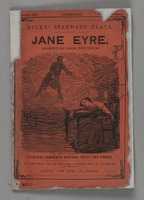 Jane Eyre: A Drama in Five Acts
 This dramatisation of Jane Eyre is part of the Dick’s Standard Plays series and is based on a version first performed in New York in 1856. Publisher John Dicks capitalised on the Dramatic Copyright Act of 1833, which granted playwrights rights over the publication and performance of their works, to produce a series of inexpensive acting editions of classic and popular works. These editions included performance rights, appealing to a growing market of both theatre enthusiasts and amateur performers.
The adaptation was written by actor, theatre manager, and prolific dramatist John Brougham. The cover features an eye‑catching illustration of a spectral Rochester appearing to Jane in a dream.
-
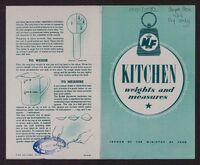 Kitchen Weights and Measures
 One of three leaflets from a series of guides produced by the Ministry of Food during and after the Second World War. The leaflets offered advice on healthy eating and nutrition, cooking for oneself, frugal approaches to food preparation, and a wide range of information related to food supply and rationing. This leaflet provides invaluable guidance on weights and measures, giving both volume and ounce equivalents for a range of common ingredients.
-
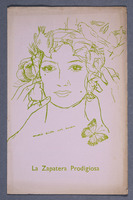 La Zapatera Prodigiosa
 Federico García Lorca’s play 'La Zapatera Prodigiosa' (The Shoemaker’s Prodigious Wife) reflects the Spanish poet and dramatist’s flair for blending folklore, humour, and social commentary. This edition, with its striking illustrated cover, celebrates Lorca’s enduring influence on Spanish literature and theatre.
-
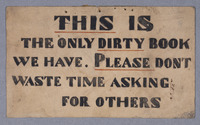 Lahr's Bookshop Sign
 This handwritten shop sign from Lahr’s Bookshop refers to the sale of “dirty” books, most likely in reference to D.H. Lawrence's 1928, privately-printed novel 'Lady Chatterley's Lover'. Blunt and practical, it reflects the pressures faced by anarchist and radical booksellers as they navigate obscenity laws, public scrutiny, and the boundaries of acceptable reading in early twentieth-century London.
-
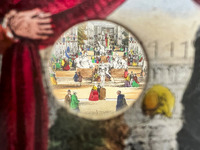 Lane's Telescopic View of the Interior of the Exhibition
 This panorama folds out from a square to give a three-dimensional view of the interior of the 1851 Great Exhibition via a peephole. The Great Exhibition was the first World’s Fair held in the purpose-built Crystal Palace in London’s Hyde Park. It attracted over six million visitors, and many souvenirs, such as this one, were produced in a range of different forms.
-
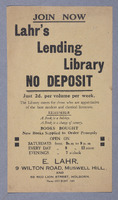 Leaflet for Esther Lahr's Lending Library
 This leaflet advertises Esther Lahr’s lending library, run alongside the Progressive Bookshop in London. Closely connected to anarchist and left-wing intellectual networks, the library offered access to radical literature that was often difficult to obtain elsewhere. Modest in format yet purposeful in tone, the printed leaflet outlines borrowing terms while signalling the political commitments behind the enterprise. It reflects how the Lahrs combined bookselling, publishing and lending as part of a broader anarchist cultural project, creating a space where print became a tool for debate, education and dissent.
-
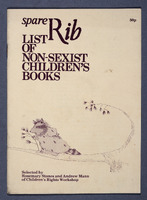 List of Non-sexist Children's Books
 A bibliography of books which fight gender stereotypes, this pamphlet is divided into four age categories from ‘under-sixes’ to ‘13 years and upwards’. The authors founded the Children’s Rights Workshop to analyse and share findings on sexist, racist and classist children’s books, and the Other Awards, to celebrate books that countered these prejudices. The pamphlet was published by feminist magazine 'Spare Rib' and distributed by the socialist Publications Distribution Cooperative.
-
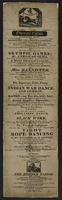 Olympic Circus
 James Bannister’s Equestrian Troup was one of the first touring circuses in Britain. From around 1810, the company toured Northen England and Scotland as the Olympic Circus, an offshoot of London’s Astley's Amphitheatre. This playbill is a rare survival that advertised a performance in Edinburgh in 1815. Bannister’s daughters were stars of the show, performing on the tight rope, slack wire and on horse back.
-
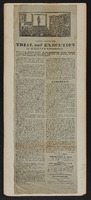 Particulars of the Trial and Execution of William Goodsell
 A cheaply printed broadside, 'Particulars of the Trial and Execution of William Goodsell' records the public execution of a 19th-century criminal in vivid, sensational detail. Sold on the streets for pennies, it was never meant to last. Yet its survival offers a rare glimpse into how ordinary people encountered news, morality, and spectacle through print — a fragile reminder of how quickly information once travelled, and how easily it could have been lost.
-
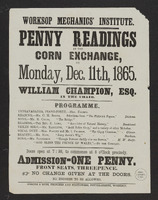 Penny Readings in the Corn Exchange
 These eight flyers, issued by the Worksop Mechanics’ Institute between December 1865 and February 1866, advertise a series of penny readings at the Corn Exchange. Penny readings were popular mid-Victorian entertainments, combining accessible instruction with amusement through songs, recitations, and music, all for the affordable price of one penny. Such events reflected the Mechanics’ Institutes’ mission to provide education and self-improvement for working communities, balancing learning with leisure. Printed by local firm Sissons & Sons, the surviving flyers, creased, foxed, and once folded, bear witness to their circulation and the enduring demand for affordable cultural life in industrial towns.
-
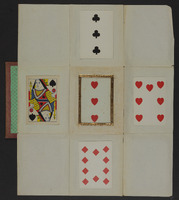 Playing Card Magic Trick Prop
 Paper novelties took many forms in the 19th century, from paper dolls to magic tricks. This curious item combines eight printed playing cards with a gold‑coloured frame attached to two sheets of paper. It was likely a variation on parlour tricks in which cards appear and vanish within a framed window. It bears the stamp of J. Robinson & Sons, Importers of Scientific Novelties, 172 Regent Street, London. Robinson was a dealer in photographic equipment and does not appear to have traded extensively in magic props.
-
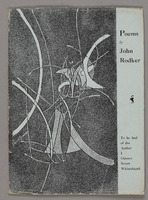 Poems
Poems Modernist writer, publisher, and translator John Rodker was one of what is today called ‘The Whitechapel Boys’ group of writers and artists. In 1914, Rodker self-published and distributed his first collection, 'Poems', as a pamphlet, complete with cover art by fellow Whitechapel Boy, painter David Bomberg. The words “To be had of the author” followed by Rodker’s home address are printed on the title page.
-
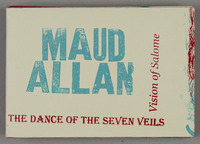 Queer Between the Covers: Maud Allan
 Part of a larger book arts work called 'Queer Between the Covers', this book focusses on dancer Maud Allan, who famously performed ‘The Dance of the Seven Veils’ in Oscar Wilde’s Salomé. In a 1918 article entitled ‘The Cult of the Clitoris’, MP Noel Pemberton Billing falsely claimed Allan used her sexuality as a German collaborator. This book work uses paper folds to suggest revelation and secrecy.
-
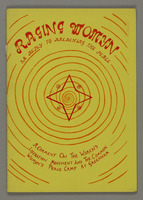 Raging Womyn: In Reply to Breaching the Peace
 Jean Freer’s pamphlet was a direct reply to the criticism's of the women’s peace movement in the 1983 publication 'Breaching the Peace'. She published it from the Greenham Common camp the following year. Freer rejected what she saw as the radical feminists’ isolationist approach to women’s liberation, arguing that the openness and mutual support fostered at Greenham had been empowering for women.
-
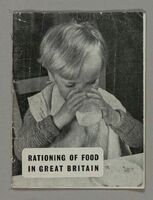 Rationing of Food in Great Britain
 This pocket‑sized booklet, published in September 1946, provided practical information on rationing following the end of the Second World War. It explained the rationale and background of rationing, as well as the quantities of rationed goods available under different schemes. It also outlined what could be obtained through canteens, schools, and communal “British Restaurants,” which provided affordable meals for workers. Food control remained essential after the War, and for some foodstuffs became even stricter. Booklets such as this were an important tool for communicating the continuing necessity of rationing.