-
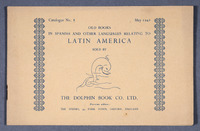 Catalogue no. 8: Old Books in Spanish and Other Languages Relating to Latin America
 Published in May 1942 by the Dolphin Book Company, this catalogue offered rare and second-hand books in Spanish and other languages on Latin America. Issued during wartime Oxford, it highlights Britain’s academic and cultural interest in the region’s history, literature, and politics.
-
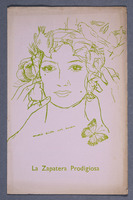 La Zapatera Prodigiosa
 Federico García Lorca’s play 'La Zapatera Prodigiosa' (The Shoemaker’s Prodigious Wife) reflects the Spanish poet and dramatist’s flair for blending folklore, humour, and social commentary. This edition, with its striking illustrated cover, celebrates Lorca’s enduring influence on Spanish literature and theatre.
-
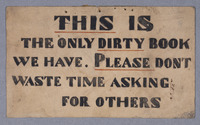 Lahr's Bookshop Sign
 This handwritten shop sign from Lahr’s Bookshop refers to the sale of “dirty” books, most likely in reference to D.H. Lawrence's 1928, privately-printed novel 'Lady Chatterley's Lover'. Blunt and practical, it reflects the pressures faced by anarchist and radical booksellers as they navigate obscenity laws, public scrutiny, and the boundaries of acceptable reading in early twentieth-century London.
-
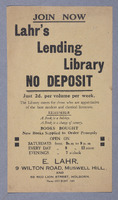 Leaflet for Esther Lahr's Lending Library
 This leaflet advertises Esther Lahr’s lending library, run alongside the Progressive Bookshop in London. Closely connected to anarchist and left-wing intellectual networks, the library offered access to radical literature that was often difficult to obtain elsewhere. Modest in format yet purposeful in tone, the printed leaflet outlines borrowing terms while signalling the political commitments behind the enterprise. It reflects how the Lahrs combined bookselling, publishing and lending as part of a broader anarchist cultural project, creating a space where print became a tool for debate, education and dissent.
-
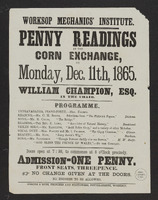 Penny Readings in the Corn Exchange
 These eight flyers, issued by the Worksop Mechanics’ Institute between December 1865 and February 1866, advertise a series of penny readings at the Corn Exchange. Penny readings were popular mid-Victorian entertainments, combining accessible instruction with amusement through songs, recitations, and music, all for the affordable price of one penny. Such events reflected the Mechanics’ Institutes’ mission to provide education and self-improvement for working communities, balancing learning with leisure. Printed by local firm Sissons & Sons, the surviving flyers, creased, foxed, and once folded, bear witness to their circulation and the enduring demand for affordable cultural life in industrial towns.