-
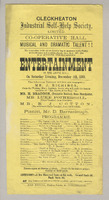 Cleckheaton Self-help Society Entertainment Playbill; Song
 This playbill advertises an evening of songs, music, and recitations held at the Co-operative Hall, Cleckheaton, on 4 December 1869. Organised by the Cleckheaton Self-help Society, the event reflects the popularity of self-help and mutual improvement movements in Victorian Britain. Societies like this encouraged working people to combine education, recreation, and moral improvement, often through lectures, reading groups, and cultural entertainments. The Co-operative Hall itself symbolised community ownership and civic pride. Though a single sheet, the playbill captures the aspirations and cultural life of an industrious Yorkshire town.
-
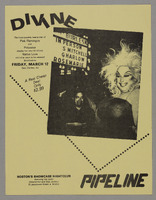 Divine: The Incomparably Insane Star of Pink Flamingos [...] With Accompanying Leaflet Queer Ephemera
 This poster, published by Camp Books in 2018 as part of the Queer Ephemera series, reproduces a Xerox flyer advertising drag icon Divine at Boston’s Pipeline nightclub on 12 March. The flyer exemplifies the DIY aesthetics of queer nightlife promotion, where photocopied posters circulated within underground club scenes. Both celebration and archive, it reflects the visibility, creativity, and resilience of LGBTQ+ communities and their cultural spaces in the late twentieth century.
-
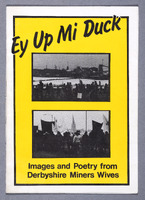 Ey Up Mi Duck: Images and Poetry From Derbyshire Miners Wives
 Created by the Derbyshire Women’s Action Group during the miners’ strike, this booklet combines poetry and images from miners’ wives. It highlights women’s voices in community struggle, capturing resilience, solidarity, and the social impact of industrial conflict in Derbyshire.
-
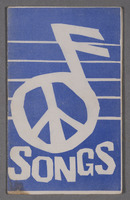 Songs
Songs This collection, published by folk singer and collector John Foreman—known as “The Broadsheet King”—brings together protest songs, traditional ballads, and spirituals. Reflecting grassroots musical activism, it illustrates how song circulated as a powerful tool of commentary, solidarity, and resistance in twentieth-century Britain.
-
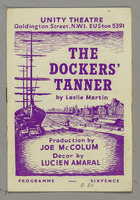 The Dockers' Tanner
 This theatre programme advertises 'The Dockers’ Tanner', a play by Leslie Martin staged at London’s Unity Theatre in the mid-1950s. Produced by Joe McColum with décor by Lucien Amaral, the play dramatises the 1889 London Dock Strike, when workers united to demand the “dockers’ tanner” (a minimum wage of sixpence an hour). Unity Theatre, known for its left-wing productions, used drama to highlight labour struggles and working-class history. At just six pages, the programme provides cast lists and production details, while also embodying the theatre’s broader mission - to make radical politics accessible through performance, solidarity, and cultural engagement.
-
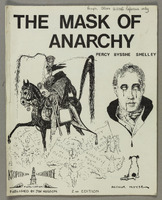 The Mask of Anarchy
 This 1973 edition of Percy Bysshe Shelley’s radical poem 'The Mask of Anarchy' was published by Kropotkin’s Lighthouse Publications, with a foreword by poet Dennis Gould. Written in 1819 in response to the Peterloo Massacre, Shelley’s call for nonviolent resistance became one of the most influential protest poems in English literature. Reissued during the 1970s, amid renewed interest in political poetry and grassroots publishing, this slim pamphlet links Romantic radicalism with contemporary struggles. Its production by a small press underscores the enduring power of Shelley’s words to inspire movements for justice, solidarity, and social change across generations.
-
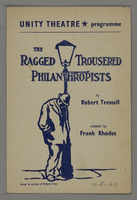 The Ragged Trousered Philanthropists
 This programme, issued by the Unity Theatre around 1949, announces a stage adaptation of Robert Tressell’s landmark novel 'The Ragged Trousered Philanthropists' by Frank Rhodes. The novel, first published in 1914, vividly depicts the struggles of working-class painters and decorators, exposing exploitation and inequality in Edwardian England. By staging it, Unity Theatre brought Tressell’s socialist message to contemporary audiences in post-war Britain. The modest three-page programme not only records cast and production details but also reflects the theatre’s enduring mission to connect political conviction with performance and to champion working-class voices on the London stage.