-
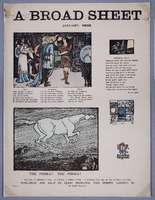 A Broad Sheet
 Between 1902-1903, publisher Charles Elkin Mathews produced a monthly series entitled 'A Broad Sheet', in a single sheet, broadside format. On display is the first issue from January 1902. This sheet features poetry by Irish writers George Moore and W.B. Yeats, whose poem ‘Spinning Song’ was first printed here. The hand coloured illustrations were by Yeats’s younger brother, Jack, and Pamela Colman Smith, who most famously illustrated the Rider-Waite Tarot deck.
-
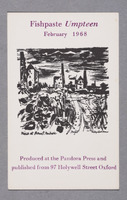 Fishpaste: Postcard Review of Art and Letters
 Printed on postcards (or postcard sized paper) which fitted in a table top Adana printing press, this ‘review of art and letters’ ran for two years on a monthly schedule. Printed at the Pandora Press by Rigby Graham, Toni Savage and Peter Hoy, each postcard contained a poem on one side and an illustration, usually by Rigby Graham, on the other. The title 'Fishpaste' was chosen as the contents of each issue were a surprise.
-
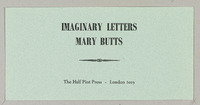 Imaginary Letters
 This work is a reimagining of Mary Butts’s 1928 modernist novella 'Imaginary Letters', which centres on eight letters. Half Pint Press’s edition interweaves content and form - each of the novella’s letters is printed as such, using different paper stocks, styles and layouts and enclosed in an envelope. The letters are tied with ribbon, as if the reader has stumbled across a stash of secret correspondence.
-
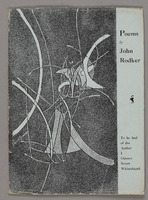 Poems
Poems Modernist writer, publisher, and translator John Rodker was one of what is today called ‘The Whitechapel Boys’ group of writers and artists. In 1914, Rodker self-published and distributed his first collection, 'Poems', as a pamphlet, complete with cover art by fellow Whitechapel Boy, painter David Bomberg. The words “To be had of the author” followed by Rodker’s home address are printed on the title page.
-
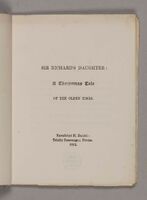 Sir Richard's Daughter: A Christmas Tale of the Olden Times
 During the 19th century, printing presses entered the middle-class home, creating a boom in ‘parlour printing’. This is exemplified by the works of CHO Daniel, who was most famous for the works he printed in Oxford. This 1852 pamphlet is from Daniel’s earlier printing phase, based at his family home in Frome. Presented in a simple blue cover wrapper, the text is anonymous although likely to have been written by Wilson Clement Cruttwell.
-
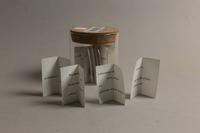 Who Finds Cells
 Created in response to Senate House Library’s 2018 ‘Rights For Women’ exhibition, this work is entirely without a spine, consisting instead of 18 small, folded slips of paper containing poetic text. The papers are housed within a glass jar, stopped with a cork. This format reflects the experience of viewing printed texts on display through the glass of an exhibition case.