-
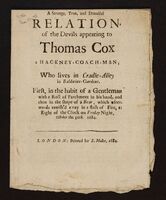 A Strange, True, and Dreadful Relation, of the Devils Appearing to Thomas Cox a Hackney-coach-man, Who Lives in Cradle-Alley in Baldwins-Gardens
 A sensationalist tract from the late 17th century. These publications featured accounts of the supernatural, crime, miracles, and even the last words of the condemned, delivered directly from the gallows. This particular tract recounts the story of a Hackney coachman who picked up a gentleman passenger—only for the man to transform into “a great black thing in the form of a bear with great flaming eyes” after refusing to pay his fare.
The pamphlet was printed by Elizabeth Mallet, a printer and bookseller who, in addition to producing sensationalist tracts, founded 'The Daily Courant', the first daily newspaper in Britain.
-
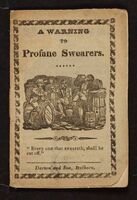 A Warning to Profane Swearers.
 A chapbook— a small pamphlet folded from a single sheet—published by an offshoot of the Darton family, who specialised in children’s books in the late 18th and early 19th centuries. It contains two stories, embellished with woodcuts, intended to teach children about the dangers of swearing and the importance of telling the truth. The first tells the story of an unfortunate enslaved woman who was struck dead by lightning after blaspheming. The second is the often‑retold tale of the young George Washington refusing to lie about cutting down a cherry tree. Works such as this give an insight into the kinds of works deemed appropriate for children and social and moral opinions of the time.
-
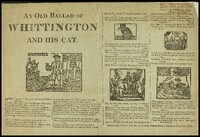 An Old Ballad of Whittington and His Cat.
 This broadside tells the popular rags‑to‑riches story of Dick Whittington, the 15th‑century mayor of London whose tale—along with the cat that helped him earn his fortune—passed into folklore. It was a favourite subject for chapbooks and broadsides like this one, often accompanied by woodcut illustrations. This example was printed and sold by John Pitts, who was based in Seven Dials, Covent Garden. In the late 18th and early 19th centuries, the area was a hub for cheap street literature.
-
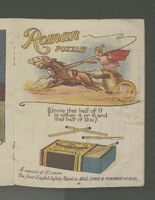 Fun Amongst the Matches
 As advances in technology made colour printing less costly, advertising and promotional ephemera in the form of leaflets, pamphlets, and flyers became increasingly common. The British match manufacturer Bryant and May produced this pamphlet in various versions in the early 20th century, using the popular pastimes of parlour puzzles and tricks to promote their match products as props.
-
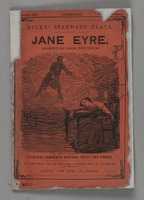 Jane Eyre: A Drama in Five Acts
 This dramatisation of Jane Eyre is part of the Dick’s Standard Plays series and is based on a version first performed in New York in 1856. Publisher John Dicks capitalised on the Dramatic Copyright Act of 1833, which granted playwrights rights over the publication and performance of their works, to produce a series of inexpensive acting editions of classic and popular works. These editions included performance rights, appealing to a growing market of both theatre enthusiasts and amateur performers.
The adaptation was written by actor, theatre manager, and prolific dramatist John Brougham. The cover features an eye‑catching illustration of a spectral Rochester appearing to Jane in a dream.
-
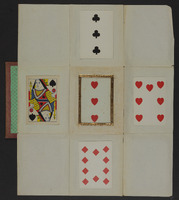 Playing Card Magic Trick Prop
 Paper novelties took many forms in the 19th century, from paper dolls to magic tricks. This curious item combines eight printed playing cards with a gold‑coloured frame attached to two sheets of paper. It was likely a variation on parlour tricks in which cards appear and vanish within a framed window. It bears the stamp of J. Robinson & Sons, Importers of Scientific Novelties, 172 Regent Street, London. Robinson was a dealer in photographic equipment and does not appear to have traded extensively in magic props.
-
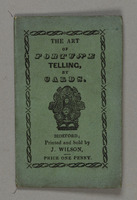 The Art of Fortune Telling, by Cards
 A chapbook on fortune telling printed in Bideford, Devon, around 1840. It has eye‑catching blue paper covers, with the title on the front and an image of Mother Shipton, a fortune‑teller popular in folklore, on the back. Inside, it describes the prophetic meanings of cards in a standard deck, from the ace of clubs promising wealth and prosperity to the deuce of spades signifying a coffin. The chapbook reflects the period’s fascination with prophecies and fortune‑telling, and with learning to practise them oneself.
-
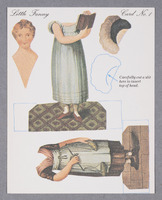 The History of Little Fanny : Exemplified in a Series of Figures.
 This pamphlet with printed paper‑doll cards is a facsimile of the first commercially produced paper‑doll kit. Paper crafts used to make toys and other novelties have existed for thousands of years, but printing made it possible to produce and distribute them commercially, and produced a growing market of toys and books for children. This facsimile was published by bibliographer Robin Alston’s Scolar Press, which produced low‑cost editions of important English works that were often scarce and survived in small numbers.