-
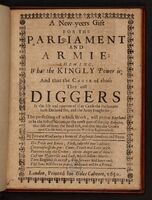 A New-Yeers Gift for the Parliament and Armie
 Gerrard Winstanley was the leader of the True Levellers, or Diggers, who advocated common land ownership and the restructuring of society into cooperative agrarian communities. This pamphlet, published in 1650, was Winstanley’s response to the overthrow of Charles I and the establishment of the English Commonwealth. In it, he appealed for further—and even more radical—change, calling for greater freedoms for all the people of England.
-
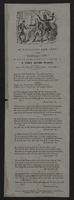 An Excellent New Song, Called "Rascals Ripe!" : In Which Some Account is Given of a Very Noted Character. Sung to the Tune of - "Cherry Ripe! Cherry Ripe!".
 A song sheet that pilloried the radical agriculturist and pamphleteer William Cobbett. It was first printed around 1820 and references several of his projects, including his promotion of new strains of corn and his attempt to bring Thomas Paine’s remains to Britain from America. The cartoon at the head of the song, by George Cruikshank, shows Cobbett selling his journal, the 'Political Register', to a hawker whose sign describes it as “two‑penny trash.” This label was coined by Cobbett’s opponents after he began selling the 'Register' as a two‑pence pamphlet to avoid newspaper taxes and make it accessible to readers in the labouring classes.
-
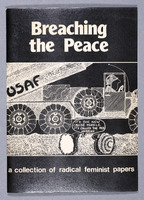 Breaching the Peace : (A Collection of Radical Feminist Papers)
 Published by Onlywomen Press in 1983, 'Breaching the Peace' was a collection of papers by radical feminists that emerged from a workshop titled “The Women’s Liberation Movement versus The Women’s Peace Movement or How Dare You Presume I Went to Greenham.” The papers examined and criticised the women’s peace movement. The contributors argued that women-only camps, such as Greenham Common, presented a media‑friendly image of women’s liberation and that being female-only did not make them inherently feminist. The pamphlet format offered a quick and convenient way to disseminate and debate the discussions that arose from the workshop.
-
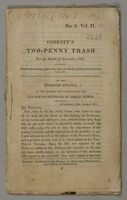 Cobbett's Two-Penny Trash
 William Cobbett was a radical politician and journalist active during the first three decades of the 19th century. He produced a periodical, 'The Political Register', to share news and political commentary with the labouring poor. In 1816, when the government imposed heavy taxes on the radical press, Cobbett responded by publishing an unstamped version of the 'Register' for two pence—mockingly dubbed “two‑penny trash” by his detractors. Cobbett embraced the insult and adopted it as the title of a monthly version of his periodical.
This issue, from November 1831, is part of the revived run of 'Two‑Penny Trash'. It survives today in much the same condition as when it was sold by hawkers nearly two hundred years ago: unbound, with the pages simply stitched together.
-
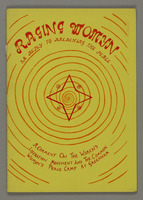 Raging Womyn: In Reply to Breaching the Peace
 Jean Freer’s pamphlet was a direct reply to the criticism's of the women’s peace movement in the 1983 publication 'Breaching the Peace'. She published it from the Greenham Common camp the following year. Freer rejected what she saw as the radical feminists’ isolationist approach to women’s liberation, arguing that the openness and mutual support fostered at Greenham had been empowering for women.
-
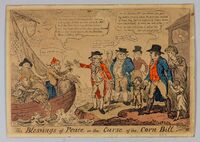 The Blessings of Peace or, The Curse of the Corn Bill
 George Cruikshank was one of the leading caricaturists and illustrators of the 19th century. Early in his career he produced prolific work on satirical prints, pamphlets, and broadsheets. A particularly fruitful collaboration was with the writer, satirist, and free‑press campaigner William Hone on a series of sharply political pamphlets. Cruikshank’s work skewered the state of politics and society in the turbulent Georgian age.
This print targets the first of the Corn Laws, passed in 1815 to restrict the importation of foreign grain after the end of the Napoleonic Wars. The legislation raised the cost of living for the poorest classes, provoking riots and fierce public opposition.
-
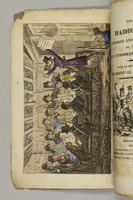 The Radicals Unmasked and Outwitted; or, The Thistle Uprooted in Cato-field / With an Engraving of the Radical Parliament.
 An anti‑radical poem, published in 1820, celebrating the discovery and arrest of a group of revolutionary radicals. In February of that year, the group plotted to assassinate Prime Minister Lord Liverpool and his cabinet as a first step toward overthrowing the government. The conspirators had been involved in earlier riots and were motivated by outrage over the Peterloo Massacre and the repressive Six Acts—legislation aimed at quelling dissent through measures such as banning “seditious” meetings and taxing pamphlets to restrict radical ideas. The pamphlet attacks prominent radical politicians and activists, and warns against the conspirators’ violent aims. Its coloured frontispiece by George Cruikshank vividly depicts the conspirators preparing for revolution.
-
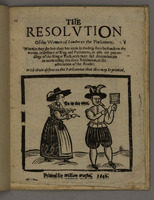 The Resolution of the Women of London to the Parliament. : Wherein They Declare Their Hot Zeale in Sendnig [sic] Their Busbands [sic] to the Warres, in Defence of King and Parliament, as Also Proceedings of the King at York
 This pamphlet was printed at the start of the First Civil War. It satirises the fervent enthusiasm of women who urged their unreliable husbands to take up arms in support of the King. On the cover is a striking woodcut print of a woman encouraging her husband—using an early version of a speech bubble—to “go to the wars.” He is shown with cuckold’s horns on his head, ignoring her as he focuses instead on a hornbook, a small paddle‑shaped board with a printed lesson sheet, usually used to teach children.