-
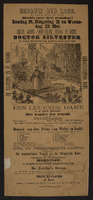 Dutch Playbill for Doctor Silvester
 A playbill advertising a performance by the English magician Doctor Silvester, who toured Australia, New Zealand, and Southeast Asia during the 1870s and 1880s. This particular playbill promotes a show in Jakarta—then known as Batavia—and features an illustration of Doctor Silvester's "Beautiful Entranced Lady" aerial suspension illusion, performed with his daughter Daisy.
-
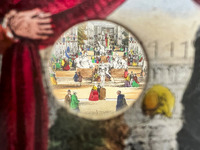 Lane's Telescopic View of the Interior of the Exhibition
 This panorama folds out from a square to give a three-dimensional view of the interior of the 1851 Great Exhibition via a peephole. The Great Exhibition was the first World’s Fair held in the purpose-built Crystal Palace in London’s Hyde Park. It attracted over six million visitors, and many souvenirs, such as this one, were produced in a range of different forms.
-
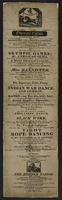 Olympic Circus
 James Bannister’s Equestrian Troup was one of the first touring circuses in Britain. From around 1810, the company toured Northen England and Scotland as the Olympic Circus, an offshoot of London’s Astley's Amphitheatre. This playbill is a rare survival that advertised a performance in Edinburgh in 1815. Bannister’s daughters were stars of the show, performing on the tight rope, slack wire and on horse back.
-
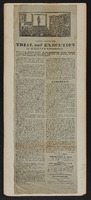 Particulars of the Trial and Execution of William Goodsell
 A cheaply printed broadside, 'Particulars of the Trial and Execution of William Goodsell' records the public execution of a 19th-century criminal in vivid, sensational detail. Sold on the streets for pennies, it was never meant to last. Yet its survival offers a rare glimpse into how ordinary people encountered news, morality, and spectacle through print — a fragile reminder of how quickly information once travelled, and how easily it could have been lost.
-
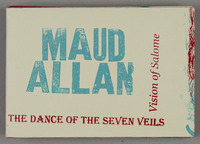 Queer Between the Covers: Maud Allan
 Part of a larger book arts work called 'Queer Between the Covers', this book focusses on dancer Maud Allan, who famously performed ‘The Dance of the Seven Veils’ in Oscar Wilde’s Salomé. In a 1918 article entitled ‘The Cult of the Clitoris’, MP Noel Pemberton Billing falsely claimed Allan used her sexuality as a German collaborator. This book work uses paper folds to suggest revelation and secrecy.
-
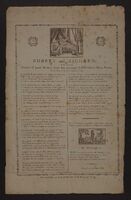 Robert and Richard; or, The Ghost of Poor Molly, Who Was Drowned in Richard's Mill Pond : To the Tune of Collins's Mulberry Tree.
 The Cheap Repository Tracts were a series of inexpensive religious, moral, and political publications—including tracts, ballads, and chapbooks—created by the writer and educator Hannah More. Aimed at the literate poor, they were produced in response to the radical and revolutionary literature circulating in England after the French Revolution, as well as to the rise of “immoral and vulgar” popular fiction. Robert and Richard is a cautionary ballad that warns of the dangers of sin.
-
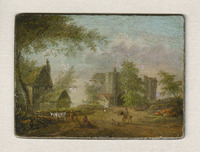 S. West’s Sale Warehouse, For Unredeem’d Pledges, Corner of Fann’s
 This object has two sides—and two uses. It was originally a engraved copper printing plate for the trade cards for an emporium selling unredeemed pawnshop goods. This use, producing ephemeral business cards, dates to around 1800. Around 1810, the valuable copper found a new purpose as the support for a miniature oil painting of a bucolic landscape complete with a thatched farmhouse, overgrown ruins, and cattle in the foreground.
-
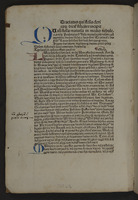 Stella Clericorum Cuilibet Clerico Summe Necessaria
 A popular treatise of the late middle-ages, 'Stella Clericorum' (star of the clerics) was written around 1200 and expounded on the dignity of the priesthood. It survives in 450 manuscript copies and at least 80 printed editions from the 15th and 16th centuries, often featuring illustrated titlepages. This edition from around 1489 was printed in Cologne and is 18 pages long. Large initials have been added to the printed text by hand in red and blue and marginal annotations and underlining throughout the text show how the pamphlet was used by its early readers. It ends with a short laudatory poem, 'In Laudem Libelli'- In Praise of the Book.
-
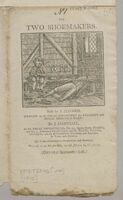 The Two Shoemakers
 'The Two Shoemakers' is a moral tale by writer and educator Hannah More, published as part of her Cheap Repository series—an initiative of inexpensive publications aimed at the literate poor, offering an alternative to radical, seditious, and immoral cheap print. The pamphlet was written by More herself and printed by the series’ first printer, Samuel Hazard, based in Bath. It was distributed by Hazard and John Marshall in London, as well as by “all booksellers, newsmen, and hawkers, in town and country.” The initial run of the series, printed by Hazard in 1795, sold hundreds of thousands of copies. To meet growing demand, printing was soon moved to Marshall’s larger operation.
-
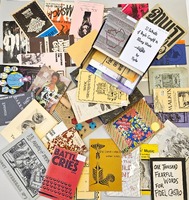 Various pamphlets
 This selection of pamphlets from one of Senate House Library's pamphlet collections reflects the abundence of 'spineless' print in our collection. With bright, engaging front covers, the contents of the pamphlets are diverse, containing works of poetry, political activism, social history and more.