-
 The playbook for women about sex
 Using her experience working in sex therapy and family planning, Joani Blank (1937-2016) founded Down There Press in 1975 to publish sex positive books. The first title was this 23-page playbook (or workbook) which uses direct language, illustrations and interactive questions to promote sexual self-awareness for women. The cover illustration is by lesbian artist Tee A. Corinne. The playbook includes sections on masturbation, honest communication with partners and body image. Blank stated that she took “the word ‘play’ very seriously”, but the workbooks also contain humour, as expressed in the final pages which contain a certificate declaring the reader a ‘Bona-Fide Sexually Self-Aware Woman’. Two years after publishing this playbook, Blank founded the Good Vibrations shop in San Francisco, selling sex toys to women. This is one of three books published by Down There Press that were seized during the raids.
-
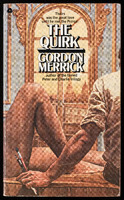 The quirk
 As with other Gordon Merrick (1916-1988) novels published by Avon Books, the cover of ‘The Quirk’ is the work of artist Victor Gadino. The style of these Avon paperbacks alludes to the romances published by Mills and Boon in the UK (or Harlequin in the USA), but in this case, they are aimed at gay readers. Gadino used male models as the basis of his illustrations which, unusually for the time, depict the men together and looking at each other rather than separate and isolated. In this instance, the full illustration wraps around the front and back covers. This novel centres on Rod, a bisexual artist in 1960s Paris who has relationships with men and a woman during the novel.
-
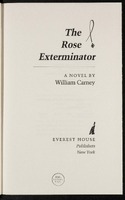 The rose exterminator : a novel
 This gay sado-masochistic mystery novel was the third and final work of fiction by William Carney (1922-1987), after ‘The Real Thing’ (1968) and ‘A Year in a Closet’ (1974). If it seems a niche subgenre, it was one Carney carved out for himself successfully, alongside employment as a university teacher of French – ‘The Real Thing’ was influenced by Pierre Choderlos de Laclos’s eighteenth-century epistolary novel ‘Les Liaisons Dangereuses’ – and as a restorer of Victorian and Edwardian houses. As well as being a guide to the S/M lifestyle and the first generation of West Coast ‘leathermen’, Carney’s books provide an insight into late 1960s and 1970s gay life in San Francisco more generally. Carney’s papers are now held at the Bancroft Library, University of California, Berkeley.
-
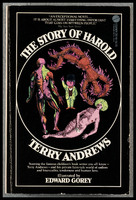 The story of Harold
 Underground classic ‘The Story of Harold’ was written under the pseudonym Terry Andrews by acclaimed children’s author George Selden (1929-1989), best-known for ‘The Cricket in Times Square’, winner of a Newbery Honor in 1961. It describes the mostly doomed, often sadomasochistic affairs of a bisexual children’s author named Terry Andrews – whose children’s book, ‘The Story of Harold’, is wildly popular – but who is otherwise on the verge of emotional and physical breakdown. Andrews finds healing by re-working incidents in his own life through stories about his character, Harold, which he relates to the young sons of his friend and lover. The novel is illustrated with several full-page pen-and-ink drawings by Edward Gorey, known for ‘The Gashlycrumb Tinies’ and ‘The Doubtful Guest’ among other works.
-
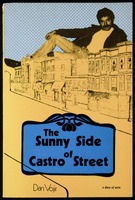 The sunny side of Castro Street : a diary of sorts
 A detailed, first-person account of bars, cruising and bathhouses in 1970s San Francisco by Dan Vojir (1947-). It also includes an extended memoir of growing up gay in a second-generation Czech immigrant family in Berwyn, Illinois, before Vojir moved to San Francisco’s Castro neighbourhood in 1974. “It’s a charmer”, proclaimed one contemporary reviewer. Vojir was a writer for the ‘Castro Times’ newspaper and worked in publishing as well as hosting a radio talk show, ‘Strictly Books’. ‘The Sunny Side of Castro Street’ is illustrated by Ku Fu-Sheng in a distinctive style which combines pencil and pen-and-ink sketches with photographic collage.
-
 The terminal bar : a novel
 Self-published by Larry Mitchell (1939-2012) of Calamus Books, one third of the Gay Presses of New York collective, this novel is set in a real Times Square bar which was popularly known as the “roughest” in New York but which was a sanctuary for its clientele. Based on Mitchell’s experiences and those of his friends, the novel follows a group of lesbians and gay men against a backdrop of a decaying America, symbolised by the Three Mile Island nuclear incident in 1979. The novel has also been considered the first work of fiction to reference AIDS. The copy of the book on display is inscribed to Gay’s The Word by the author “In defence of the freedom to read”.
-
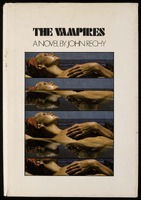 The vampires
 This novel is the second by Mexican-American author John Rechy (1931-) to be seized during the ‘Operation Tiger’ raids. The vampires of the title are metaphorical, as a disparate group of people gather on a Caribbean island and unleash their darkest desires via Satanic rituals and witchcraft. The novel is filmic in style and has a character list which includes actresses, priests (Voodoo and Catholic), a “madam”, a possibly murderous male sex worker and “a drug goddess”. In one of their catalogues, Philadelphia gay bookstore Giovanni’s Room described this novel as a departure for Rechy, particularly as it was “non-gay”, although ‘Gay Times’ noted it still had enough in the contents to be interesting to gay readers.
-
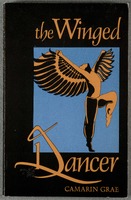 The winged dancer
 A “grown-up lesbian adventure story”, according to New Zealand’s feminist magazine ‘Broadsheet’. Part murder mystery, part tale of psychological development, part love story, it describes lesbian feminist Kat Rogan’s journey from Chicago to the fictional Latin American country of Marigua. Rogan spends time in prison, solves the case and also comes to terms with the dominant and submissive sides of her personality. The book was criticised by some reviewers for exoticising South America and failing to engage with the politics of the region. Camarin Grae (1941-), author of ‘Paz’ (1984) and ‘Soul Snatcher’ (1985), among other works, was the owner of Blazon Books – this was their first title.
-
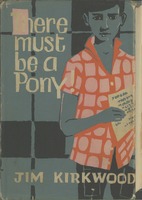 There must be a pony!
 Written in a style distinctly reminiscent of J.D. Salinger’s ‘The Catcher in the Rye’ (1951), this is the story of “sensitive” sixteen-year-old Josh, his film star mother Rita Cydney, and her relationship with the mysterious Ben. Its queer content is largely subtextual, but a 1963 write-up in the ‘Mattachine Review’ by Gene Damon (pseudonym of legendary lesbian bibliographer Barbara Grier) noted its “sensitive handling of a boy’s first comprehension of homosexuality, with the aid of an older, well-presented man”. ‘There Must Be a Pony!’ was adapted into a television drama in 1986, starring Elizabeth Taylor as Rita. James Kirkwood (1924-1989) stated in an interview that the book was based on his own relationship with his mother, actress and silent film star Lila Lee, about whom he said, “She should have had puppies or kittens, not a kid”. Kirkwood’s ‘'P.S. Your Cat is Dead’ was also seized in ‘Operation Tiger’.
-
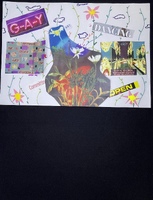 Together we are…
-
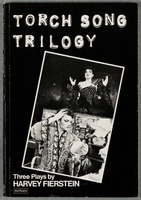 Torch song trilogy : three plays
 ‘Torch Song Trilogy’ has three acts titled ‘International Stud,’ ‘Fugue in a Nursery’ and ‘Widows and Children First!’ Each deals with a different phase in the life of Arnold Beckoff, a gay, Jewish drag queen and torch singer in 1970s and 1980s New York. Receiving criticism from some for upholding ‘family values’, for others, the trilogy’s exploration of gay marriage and adoption was radical during a time of conservative backlash. Harvey Fierstein (1954-) won a Tony Award for Best Play in 1983 as well as for Best Performance by a Leading Actor. First published in 1981 by the Gay Presses of New York, this edition was published in the UK to tie in with its West End premiere at Albery Theatre (now the Noël Coward Theatre) in 1985. Fierstein has since blazed a trail for queer representation on stage and screen.
-
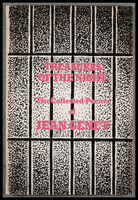 Treasures of the night : the collected poems
 A collection of six long poems by Jean Genet (1910-1986), first published between 1942 and 1948. They are presented here in a bilingual French/English version for the first time by translator Steven Finch, with the authorisation of Jean Genet and publisher, Éditions Gallimard. The French original occupies the verso (left hand side) and the English is printed on the recto (right hand side) in a facing page layout. Finch describes Genet’s poems as “a rich contribution to the expression of the gay movement and spirit”. This edition also includes the cover artwork of the rare first edition of Genet’s ‘Poèmes’, published by L’Arbalète in 1948, as well as striking, graphic black-and-white drawings by Bill Sullivan.
-
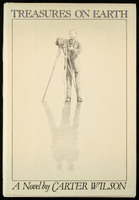 Treasures on earth : a novel
 This novel is a fictionalised depiction of a real expedition to Machu Picchu in Peru which was undertaken by Hiram Bingham in 1911. Running parallel to the main narrative is the story of the trip’s photographer, Willie Hickler, who discovers his sexuality when he falls in love with the expedition’s Peruvian assistant, Ernesto. Author Carter Wilson (1942?-), who later became an academic and Professor of Community Studies, described this book as “my coming-out novel”. The book was published by the well-established Knopf imprint and received good reviews, including from Christopher Isherwood who compared it to E. M. Forster’s ‘A Passage to India’.
-
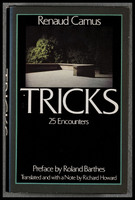 Tricks : 25 encounters
 “Homosexuality”, Renaud Camus (1946-) reminds the reader of ‘Tricks’ in his foreword, “has a history, and of course, a geography”. These stories of sexual encounter, translated by distinguished gay poet Richard Howard (1929-2022), move from late 1970s Paris to Milan to the United States. In the preface, literary theorist Roland Barthes notes these short narratives’ simplicity, their repetitive nature, and also their status as literature rather than pornography. Each begins with a name and a date, before detailing a sexual liaison between Camus and a man he has never met before. Each ends with a note on their subsequent relationship (if any). Previously a columnist for ‘Gai Pied’ and a socialist, Camus is now a conspiracy theorist and white nationalist, who developed the far-right ‘Great Replacement’ theory.
-
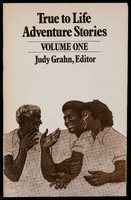 True to life adventure stories. Vol. 1
 Judy Grahn (1940-) is a poet, lesbian feminist and advocate of women’s spirituality. She also wrote 1984’s ‘Another Mother Tongue’, a mythic queer history. In response to Grahn’s question, “what is a woman’s adventure story?”, this book presents stories by twenty writers which relate women’s direct experiences. Writing by working-class women is a strong feature of the collection, with an emphasis on maintaining the authors’ unedited natural language and spelling. The book was published by Diana Press, a feminist printing and publishing house founded in 1972 by Coletta Reid and Casey Czarnik. The cover illustration is by Karen Sjöholm, who also worked at the Press. The Press was vandalised in 1977, with damage to plates, paste-ups, books and machines. It closed in 1979.
-
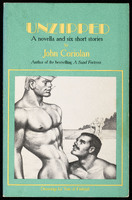 Unzipped : a novella and six short stories
 The opening line of the first short story in this collection, aptly illustrated by Tom of Finland (Touko Laaksonen), gives a representative flavour – “At fourteen, Vincent Conte didn’t know whether he had a big cock or an ordinary one – at fifteen, he found out”. The back cover blurb declares that “Through all seven pieces runs a single theme – the explicitly detailed celebration of male-male sex, the excitement, the romance, the fun of it”. One reviewer for Australian publication ‘OutRage’ was less impressed, however, stating that the illustrations were the most exciting part of the book. American author John Coriolan wrote several other erotic novels from the late 1960s onwards.
-
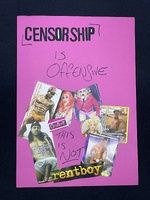 We Miss You, Gerald
-
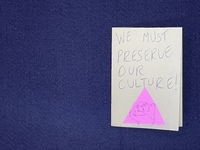 WE MUST PRESERVE OUR CULTURE!
-
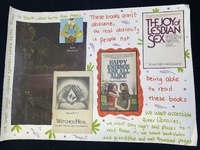 We want friendship and well thumbed pages
-
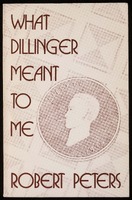 What Dillinger meant to me
 This poetry collection from Robert Peters (1924-2014), his eighteenth, contains a mix of new poems and some that were published in earlier books and little magazines, such as ‘The Berkeley Poetry Review’. This volume is autobiographical, focussing on the poet’s childhood, family and society in rural Wisconsin during the Great Depression of the 1930s. The American gangster John Dillinger was involved in a shootout in the nearby Little Bohemia Lodge – his image adorned the young Peters’s bedroom wall, and he appears throughout this collection. Peters’s burgeoning sexuality is explored in poems such as ‘Tommy McQuaker’, about a local gay man who defiantly “walked like a woman down Main Street”, inspiring both fear and desire. Published by the Sea Horse Press, the book is dedicated to Peters’s parents.
-
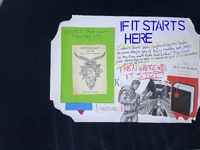 Where will it stop?
-
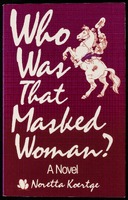 Who was that masked woman?
 Bertha Harris, co-author of ‘The Joy of Lesbian Sex’, described this coming-of-age novel as “an authentic slice of lesbian Americana”. The novel follows young lesbian Tretona Getroek, from her childhood on a farm amidst religious Revival meetings, through to university and travels that take her to Turkey and England. She also explores her sexuality while combatting the prejudices of the church, education and psychiatric establishments. Tretona is the masked woman of the title, hiding her identity. Noretta Koertge (1935-) wrote a sequel to this novel, 1984’s ‘Valley of the Amazons’, and was part of the Daughters, Inc. publishing collective. She is currently Emeritus Professor of the History and Philosophy of Science and Medicine at Indiana University.
-
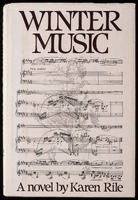 Winter music
 Set in the Philadelphia classical music scene of the late 1970s, Karen Rile’s first and only novel concerns gay concert flautist Lawrence Chatterjee, whose performance career has been cut short following an accident, and child flute prodigy Gabriel, who also loves Kool-Aid and the Beatles. Rile herself studied flute at university level, before going on to become a writer and journalist for publications including ‘The New York Times’, ‘The San Francisco Chronicle’ and ‘The Philadelphia Enquirer’, and her fiction and creative nonfiction have appeared in several literary magazines. She teaches fiction and creative nonfiction at the University of Pennsylvania.
-
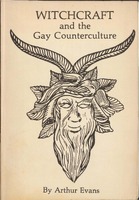 Witchcraft and the gay counterculture : a radical view of Western civilization and some of the people it has tried to destroy
 This book by Arthur Evans (1942-2011) is a rebuttal to the homophobic bias of “professional historians” and academics. Merging myth and history, the text is a self-proclaimed radical and subjective vision of a pre-Christian world of nature societies, which touches on many themes including Druids, Gnosticism, witchcraft, matriarchy, class politics and magic as a collective endeavour. Published by the Boston-based Fag Rag collective, it was edited by two of its members, Michael Bronski and Charles Shively, and chapters were initially published in the journals ‘Out’ and ‘Fag Rag’. Active in gay liberation movements, Evans was a co-founder of the Gay Activists Alliance and of the San Francisco Faerie Circle. This text is still in print in pirated editions and remains popular with Radical Faeries.
-
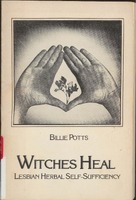 Witches heal : lesbian herbal self-sufficiency
 Billie Potts (1940-2013) was one third of Elf and Dragons, self-described “lesbian witches”, who were a Woodstock-based women’s land collective, a publisher, distributor of herbs and part of a wider feminist spirituality movement. Women’s rural collectives were common in the USA at this time. Potts’s book is a guide to herbalism and an “access tool”, promoting self-sufficiency and encouraging lesbian women to reclaim their role as healers. The book proved controversial as its publication coincided with an acrimonious split within Elf and Dragons. Susun R. Weed accused Potts of using her work uncredited and asked feminist bookshops not to stock the book. The ‘Operation Tiger’ raids were not, therefore, the first attempts to restrict this book.
