-
 Men behind bars : sexual exploitation in prison
 This is an in-depth study of exploitative and consensual sex between men in prison, drawing on qualitative interviews with men in a medium-security correctional facility in California. It covers themes such as the prison setting, prison policy and staff attitudes towards homosexuality. Wayne Wooden, a sociologist, was based for several years at Cal Poly Pomona. He has also worked on aging and was an active member of the National Association of Lesbian and Gay Gerontology. First published by New York’s Plenum Press in 1982, ‘Men Behind Bars’ was then published by Da Capo in 1983 – this is the paperback edition of the following year.
-
 Men in erotic art
 This is a catalogue of artists represented by the Rob Gallery, based in Amsterdam and later also in New York, which exhibited male erotic art. Rob started as a leather worker catering for men, and the themes of leather and S&M continued in the art represented by the gallery. The catalogue is an introduction to this work and the artists, including Tom of Finland (Touko Laaksonen), Nigel Kent (aka James D.), Olaf and Orsen. The catalogue also introduces the Art Matchboxes series, limited edition matchboxes containing erotic prints by a single artist.
-
 Men loving men : a gay sex guide and consciousness book
 Disappointed by the heterosexism of ‘The Joy of Sex’ (1972), Mitch Walker (1951-) produced this practical sex guide for men “who want to love other men” and “be themselves”, in the same year as Charles Silverstein and Edmund White published ‘The Joy of Gay Sex’. Walker also emphasises queer kinship, distinguishing a more emotionally and socially encompassing “gayness” from a medico-scientific “homosexuality”. Explanations of sexual acts such as masturbation and fellatio are interspersed with quotations and images on love and sex between men from other times and cultures. The book is illustrated with expressive line drawings by Bill Warwick and black-and-white photography by David Greene. Copies of ‘Men Loving Men’ sent to ‘Gay News’ in the late 1970s were destroyed by Customs. It also met with Customs’ disapproval in Canada and New Zealand, where it was banned as indecent in 1983.
-
 Men loving themselves : images of male self-sexuality
 The publisher of this book, Down There Press, was founded by sex therapist and feminist Joani Blank (1937-2016), to publish works advocating for sex positivity. She also edited this book which explores male masturbation, primarily through black-and-white images of men depicted in the act. Jack Morin (1946-2013) photographed twelve straight and gay men in settings of their choosing, alongside statements outlining how masturbation relates to their sexuality. The book ends with a section entitled ‘The Psychology of Male Self-Sexuality' which provides a conceptual framework for the images. It includes a list of recommended readings, and an advert for a poster of the book’s cover, available to purchase. Other books exploring gay men’s sexuality, ‘The Joy of Gay Sex’ and ‘Men Loving Men’, were also seized during ‘Operation Tiger’.
-
 Moral Panic!
-
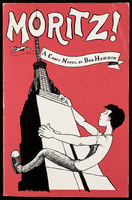 Moritz! : a comic novel
 A review of this novel described it as “a trashy book” but one that was nonetheless enjoyable thanks to its absurdist and silly humour. This satirical novel follows Jellico Moritz, a “well-endowed” young man, who travels from rural America to a new life and sexual awakening in New York City. The final chapter, entitled ‘Moritz Goes to a Garden Party’, was first published in ‘A True Likeness’ which was edited by Felice Picano. The book was published by Larry Mitchell’s Calamus Books which was one third of the Gay Presses of New York collective.
-
 Mr. Benson
 First published in 1983 by San Francisco-based publishers Alternate, John Preston’s classic S/M novel details a young man’s slave/master relationship with the sadistic and dominant Mr Benson. Preston (1945-1994) was involved in the civil rights and anti-war movements of the 1960s, as well as in gay activism. By 1975, he was editor of national gay newspaper, ‘The Advocate’. In the 1980s, he combined his writing of erotica and pornography with more mainstream anthologies about gay life. In 1995, he posthumously received a Lambda Literary Award and was a finalist for the American Library Association’s Stonewall Book Award for 'Sister and Brother’, a nonfiction anthology co-edited with Joan Nestle. In 1994, the year of his death from complications from AIDS, he received the Steve Maidhof Award from the National Leather Association International, who inaugurated a short story prize in his name in 2007.
-
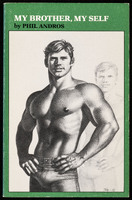 My brother, my self
 This is the second of three Phil Andros (pseudonym of Samuel M. Steward, 1909-1993) titles seized during the raids. As with the other Andros titles published by Perineum Press, the cover is a specially commissioned Tom of Finland (Touko Laaksonen) illustration of the Phil Andros character (Steward was very pleased with these drawings). This novel was first published in 1970 by pulp publisher Gay Parisian Press under the title ‘My Brother, the Hustler’, so the title was altered to avoid legal issues. Featuring more sexual exploits of the character Phil Andros, the “brother” of the title is his doppelgänger, Denny. The two men can psychically communicate and are often confused for one another.
-
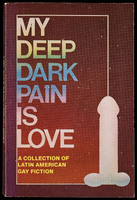 My deep dark pain is love : a collection of Latin American gay fiction
 This anthology, edited by Winston Leyland (1940-), presents a selection of short stories, novellas and excerpts from longer works from a wide range of male Argentinian, Mexican, Cuban, Chilean and Brazilian authors. It is illustrated with graphic line-drawings by Argentian artist Jorge Gumier Maier and is a follow up to Gay Sunshine Press’s ‘Now the Volcano’ (1979) which focused on Mexico, Brazil and Colombia. Like the first anthology, Brazilian literature predominates in this collection. It is a collaboration between Leyland, who travelled extensively in Latin America, and frequent Gay Sunshine translator, E. A. Lacey (1938-1995). The two anthologies form part of a small body of books from Gay Sunshine Press with a Latin American focus, including Luis Zapata’s ‘Adonis García’ and Adolfo Caminha’s ‘Bom-Crioulo’, both of which were also seized in the ‘Operation Tiger’ raids.
-
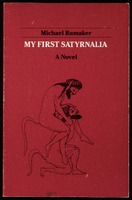 My first satyrnalia
 One of two Michael Rumaker (1932-2019) books seized, this novel follows a narrator through a night in New York, on the streets, in the bookshops and in “make-out booths”. The narrator’s ultimate destination is an apartment where a Fairy (Faerie) Circle is gathering for the Saturnalia of the book’s title, an “orgiastic celebration” of the Winter Solstice. The Fairy Circle refers to a meeting of the Radical Faeries, a countercultural movement founded in 1979. The novel is scattered with references to non-fictional locations, books and music, including the Oscar Wilde Memorial Bookshop on Christopher Street, Donna Summer and Arthur Evans’s book ‘Witchcraft and the Gay Counterculture’ (also seized in ‘Operation Tiger’). The novel, therefore, provides a sense of gay culture in Greenwich Village as it was forty years ago.
-
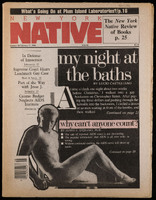 New York native. Issue 82, January 30-February 12, 1984
 Published biweekly between 1980 and 1997, this is a relatively early edition of ‘New York Native’. Much of the paper’s reporting at this time concentrated on the growing AIDS crisis, and this issue is no exception, with headline statistics and an editorial concerned with a potential link between the human immunodeficiency virus (HIV) and the African Swine Fever virus. While a paper supporting this theory appeared two years later in medical journal ‘The Lancet’, it was later discredited. Also featured are music, theatre, film, gallery and restaurant reviews, guides to New York and San Francisco, a letters page, classified ads and personal ads.
-
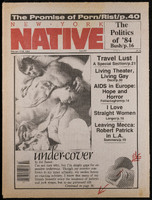 New York native. Issue 83, February 13-26, 1984
 The ‘New York Native’ newspaper was published by Charles Ortleb (1950?-) between 1980 and 1997. This issue contains articles, reviews, personal listings, adverts, a fashion spread and a winter travel supplement. Most notable is the range of reports on AIDS, which begin with an editorial critiquing the racism and homophobia in press reports of the crisis. Other articles in this issue focus on the first European conference on AIDS and lists of numbers of cases reported in New York. The paper first reported on AIDS in 1981, after the ‘New York Times’ broke the story on 3 July that year. ‘New York Native’ had been pioneering in its coverage, although it later fell out of favour and was boycotted by some activists when it began to promote conspiracy theories regarding the cause of AIDS.
-
 Notes from a marriage : love poems
 Since the mid-1970s, the creative output of Gavin Geoffrey Dillard (1954-) has encompassed many forms including poetry, songwriting and acting in pornographic films. This poetry collection, Dillard’s third, explores the emotional and sexual relationship between two young men, with some undertones of violence. It was published in New York by Felice Picano’s Sea Horse Press. In 1988, Australian gay rights activist Dennis Altman described Dillard as “the laureate of the sensual”, while Dillard’s poetry forms the basis of Clint Borzoni’s 2014 opera ‘When Adonis Calls’. Today, Dillard self-publishes books under his Gavin Dillard Poetry Library & Archive imprint and recently produced a new text and photographic edition of ‘Notes from a Marriage’.
-
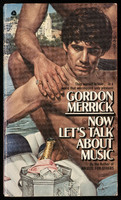 Now let's talk about music
 Riding high on his wildly popular Peter and Charlie trilogy (also seized by Customs), Gordon Merrick (1916-1988) continued to publish paperback romances with Avon into the 1980s. ‘Now Let’s Talk About Music’ gave Merrick’s fans more of what they wanted – exotic locations (Thailand, a yacht off the coast of Sri Lanka), rich, beautiful gay men, steamy sex scenes and page-turning drama. “Another winner from the gay Harold Robbins” proclaimed a reviewer for ‘Gay News’ in December 1982. As with several other Merrick titles published by Avon, the cover art is by Victor Gadino, a noted illustrator of romance and erotica.
-
 Now the volcano : an anthology of Latin American gay literature
 Edited by Winston Leyland (1940-) and published by his Gay Sunshine Press imprint, this book is an anthology of short stories, poems, novel excerpts and a memoir, interspersed with illustrations. The collection presents a snapshot of gay male writing from Latin America, with an emphasis on Brazilian literature, which Leyland notes is the richest, including ‘Bom-Crioulo’ which was first published in 1895 (and which was also seized during ‘Operation Tiger’ as a separate title). The book’s title refers to Malcolm Lowry’s Mexican-set novel ‘Under the Volcano’. Translator Erskine Lane’s own novel, ‘Game-Texts – a Guatemalan Journal’, was also published by Gay Sunshine Press and seized during the raids.
-
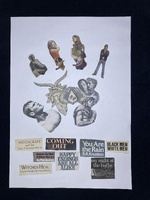 One book ban
-
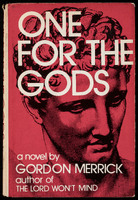 One for the gods : a novel
 The second book in the Peter and Charlie trilogy by Gordon Merrick (1916-1988) and the couple, now a decade into their relationship, move from the South of France to Greece. The copy on display is the original Bernard Geis Associates edition from 1971. The cover design, by Roy E. LaGrone, is of a sculpted Greek head rendered in black ink against a red background, overlaid with large, sans-serif white lettering. It lends the book a serious air – this could be a historical novel or a textbook – at odds both with its content and with the smouldering pulp covers of later Merrick editions, as published by Avon Books. Bernard Geis was also responsible for Jacqueline Susann’s ‘The Valley of the Dolls’ in 1966, one of the bestselling novels in publishing history.
-
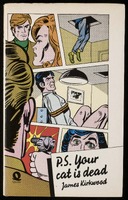 P.S. your cat is dead
 A darkly comic exploration of the burgeoning relationship between down-on-his-luck actor Jimmy Zoole and a gay cat burglar he finds looting his apartment. This is the third novel from author and playwright James Kirkwood (1924-1989). According to biographer Sean Egan, Kirkwood was inspired by a series of burglaries at his home on West 58th Street, New York. In their 1979-80 catalogue, Philadelphia bookstore Giovanni’s Room described ‘P.S. Your Cat is Dead’ as “our all-time bestselling gay men’s novel”. Kirkwood adapted it into a play in 1975 and in 2002, it was adapted again into a feature film, directed by Steve Guttenberg, which was rather less well-received. Kirkwood’s ‘There Must Be a Pony!’ was also seized in ‘Operation Tiger’.
-
 Parents of the homosexual
 This book was published as part of the ‘Christian Care Books’ series, a set of practical guides which dealt with contemporary social experiences from a Christian pastoral care perspective. The series was edited by Warren E. Oates, a pastor and psychotherapist. This volume is aimed at Christian parents of gay or lesbian children, particularly those who are struggling with their children’s sexuality. Authored by Shirley Switzer, a mental health psychologist, and pastor David Switzer (1925-2015), this book draws on real conversations with the intention of lovingly reconciling families. The book also includes a chapter which critically engages with the Bible and challenges its use as an excuse for homophobia.
-
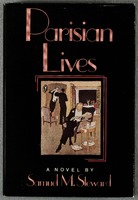 Parisian lives : a novel
 Samuel M. Steward (1909-1993) was, amongst other things, an academic, a novelist, a pornographer and a tattoo artist. During the 1930s, he befriended writer Gertrude Stein and her partner Alice B. Toklas. Both feature in this novel, which follows their painter protégé, Francis Rose (fictionalised as Arthur Lyly), in Paris just prior to the Second World War. The first paragraph sets a tone which blends fact and fiction, highlighting an ambiguity that was typical of Steward and which can also be seen in his writings under the pseudonym Phil Andros, some of which were also seized during the ‘Operation Tiger’ raids. Written and edited over a thirty-year period, this novel was published in 1984 by Michael Denneny at St. Martin’s Press.
-
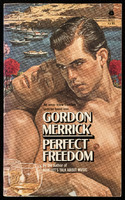 Perfect freedom
 This is another of Gordon Merrick’s (1916-1988) romance and sex novels published in paperback by Avon, with Victor Gadino illustrated covers. Avon was the paperback division of the Hearst Corporation, and ‘Gay Times’ claimed that publishing these novels was Avon's attempt to “cash in on the post-Stonewall gay market”. Based on one of his earlier novels, ‘Demon of Noon’ (1954) – an at-times-coded gay novel which is less explicit than his later work – this story is set in 1938 on a cruise in the Greek Islands and features Robbie’s sexual awakening with multiple partners. Some of the men he meets during his journey are listed and briefly described before the novel’s title page, including an “Italian deckhand”, a “Greek Adonis”, and a “brooding biker”. The title of the novel is a quote from E.M. Forster’s ‘The Longest Journey’.
-
 Piece of Art.
-
 Proust & the art of love : the aesthetics of sexuality in the life, times, & art of Marcel Proust
 Volume four of Marcel Proust’s (1871-1922) seven volume novel ‘À la recherche du temps perdu’ (‘In Search of Lost Time’) is entitled ‘Sodome et Gomorrhe’. Published in 1921/22, volume four is an early literary representation of gay and lesbian sexuality, focussing on characters including the decadent Baron de Charlus. Written by Julius Edwin (J.E.) Rivers (1944-), this book is a scholarly study and critique of Proust’s depiction of homosexuality covering biographical, historical and psychological elements. The book was published by the academic Columbia University Press and is held in multiple UK university libraries.
-
 Queer Books: A Map
-
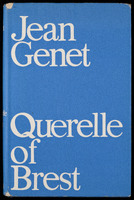 Querelle of Brest
 Set in the French port town of Brest, bisexual anti-hero Georges Querelle is a young sailor lusted after by his superior officer, by a local corrupt policeman and by the madam of a brothel. But Querelle is also a thief and a serial killer. ‘Querelle of Brest’ by Jean Genet (1910-1986) was first published anonymously in 1947 in a limited edition and illustrated with a series of homoerotic and sexually explicit line drawings by Jean Cocteau. It was prosecuted in France on grounds of indecency in 1954 but cleared in 1956. This edition from 1966 marks its first translation into English by Gregory Streatham. Rainer Werner Fassbinder’s last film, ‘Querelle’ (1982), is an adaptation of the novel. Genet himself was dishonorably discharged from the French Foreign Legion and imprisoned for committing ‘lewd’ (homosexual) acts.
