-
Title
-
De proprietatibus rerum
-
Heading
-
Caxton's first book
-
Description
-
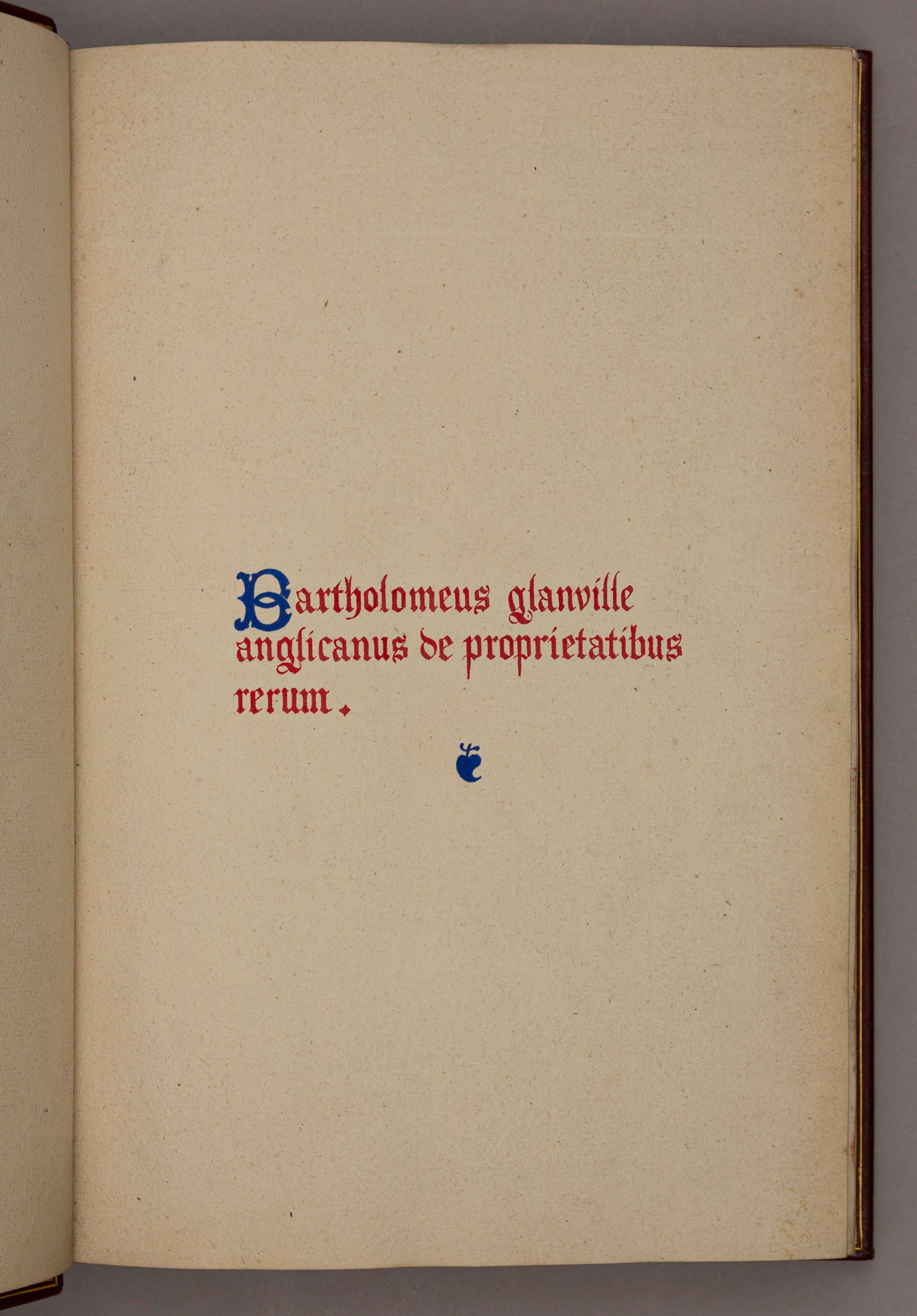
William Caxton learned and practised printing in the low countries before moving to Westminster. His very first book is also the longest. It is the editio princeps of De proprietatibus rerum (‘On the properties of things’), produced in Cologne in 1471. The work was an essential source of information for readers throughout Europe. It is a mediaeval encyclopaedia, thought to have been written in the 1240s by the Oxford graduate and Franciscan friar Bartholomaeus Anglicus (‘Bartholomew the Englishman’). Its nineteen sections cover theology, philosophy, medicine, astronomy, chronology, and the natural sciences from botany through to mineralogy, thereby moving from God to man to lesser orders of being, in the standard hierarchy of the time. Bartholomaeus Anglicus wrote it to help his fellow Franciscans to general knowledge without their having to become expert in each discipline. Manuscripts of the book circulated widely, both in the original Latin and in translation. It was therefore an obvious candidate for printing, as a certain bestseller. The fact that Caxton chose to produce the book in the original Latin indicates a continental consumer group.
Caxton’s name is not mentioned in the book, and we know about his involvement only because Wynkyn de Worde tells us of it in his edition of John Trevisa’s fourteenth-century English translation (about 1496). Caxton’s major contribution to the book was to finance it. While he may have assisted with the printing, the main printer was Johan Veldener, a German who was also a typecutter and who supplied Caxton with his first three types.
Note the ‘Lombardic’ initials and the paragraph marks in manuscript, which show the transition from manuscript to print in hybrid books which were finished by rubricators, and show how incunabula were made to look like the manuscripts from which they evolved. The type is based on the forms of script used in Cologne monasteries.
-
Date of Publication
-
ca 1471
-
Format
-
Folio
-
Century
-
15th
-
Illustrations
-
Manuscript

 The BeginningsSee all items with this value