9. Hungarian refugees from the Soviets: the continued need for asylum
Senate House, Malet Street
After the Second World War, Senate House was able to return to its original purpose – the headquarters for the Federal University of London. Of course, the end of the war did not mean an end to refugees arriving in London. The next wave were the Hungarians. And between the refugees from the Nazis and these new refugees, the UN published its 1951 Refugee Convention. This convention defined countries' international obligations to refugees and set out refugees' basic rights and entitlements.
In October 1956, there was a revolution in Soviet-controlled Hungary. This conflict, and its violent suppression by the Soviets, led to around 200,000 refugees leaving the country. Of these, 22,000 were admitted to the UK, and some came to Bloomsbury. We can see from the University of London’s Student Union’s newspaper that there was something about the Hungarian revolution that caught the sympathy of London’s students. It was a revolution for freedom, against Soviet repression, and it had begun with Hungarian students protests – in which some of those students were shot and killed. As details continued to emerge during the November of 1956, members of the University of London signed petitions and took part in protests to express their ‘revulsion’ at the Soviets’ brutality. And, indeed, when Hungarian refugees arrived in Britain they received considerable state and public support – very unlike the experiences of previous refugees.
The University of London Hungarian Relief Appeal was launched by the Students’ Union as early as the 29th October to raise money for food, clothing and medical supplies. On the morning of Tuesday 30th October members of the School of Slavonic and East European Studies were here, outside Senate House, starting a ‘mile of pennies’ that led to Birkbeck College by that evening. By Thursday evening the line of pennies stretched into the corridors of Senate House and led all the way to Sicilian Avenue to the south of us. Despite the ‘buffeting wind’ they raised £178 over the three days. (Image 9.1) In December, the University of London choir raised money for the appeal, singing carols to commuters.
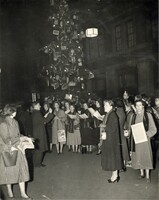

By the end of November it was becoming clear that the university should do more, especially for Hungarian students. The University, its Graduates’ Association and ULU aimed to raise £20,000 to provide scholarships. By January 1957, 40 Hungarian students had arrived, and it was known that at least £50,000 would be needed to support them to finish their studies. On Saturday 12 January, the University’s Graduate body, ‘Convocation’, met at Senate House to update on the appeal. The chair reported that the results of the appeal ‘had exceeded all expectations’. Donations had been received from all over the world. And apart from financial contributions there were many offers of hospitality and of help in the teaching of English.
Two Hungarian students were at the meeting – they had written to thank the University of London Graduates, and now wanted to thank them personally. The Minutes of the meeting tell us what they said:
Paul Hollander, a Hungarian student now at the London School of Economics, expressed appreciation of the kindness and sympathy shown to the refugees on their arrival in this country, and of the generosity of Convocation in helping to make it possible for them to continue their studies. Mr N. Niery, a Law student from Budapest, speaking in Hungarian translated by Mr Hollander added his thanks for the help given by the University, which would not only benefit the students themselves but would also strengthen the cause of international friendship.Minutes of Ordinary Meeting of Convocation held Saturday 12 January 1957, University of London Archive, UoL CN 1/3/8
As a Jewish Hungarian, Hollander remembered, when he was a child, having to hide from the Nazis during the occupation of Hungary. Now he had had to flee the Communists. Following his studies at LSE he went on to an academic career in the USA, where he was also a member of the national advisory council of the Victims of Communism Memorial Foundation.
Another group which mobilised to support the Hungarian Refugees was the Association of Jewish Refugees, seeing it very much as their duty, now that they had managed to settle into the UK, to help newcomers.
Learn more
As we finish our walk, we invite you to pause and consider the UK's, and Bloomsbury's, relationship with refugees over the years. To learn more about this subject, the groups of refugees featured in this exhibition, and the archives that supported this research, see our page: Archives and Resources