7. Refugee journalists in London: 'are refugees an asset?'
Senate House, Russell Square
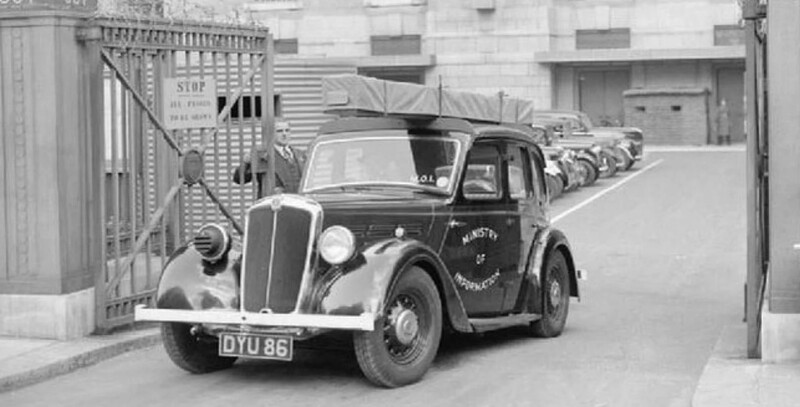
When Senate House was completed to house the University of London's headquarters, the university had barely moved in when war broke out and the building was taken over by the Ministry of Information. The Ministry of Information (MoI) was responsible for communication at home and abroad on behalf of the government, issuing publicity and propaganda material as well as deciding what information was to be censored. A contemporary description of the room was published in 1944:
The Ministry created a vast amounts of content such as films, radio programmes, and posters, including the now ubiquitous poster: 'Keep Calm and Carry On'. They commissioned artists, writers, journalists, and film directors to do this work. Amongst them were many refugee journalists and creatives.
Émigré journalists and intellectuals were instrumental in creating anti-Nazi propaganda, much of it broadcast via the BBC to occupied Europe. The programmes provided more accurate information about the progress of the war, and tried to counter-act Nazi propaganda. Listening to the BBC was illegal under the Nazis so many listened at very low volume or with their head under a blanket. Programmes therefore had to be short, simple and consistent in order to be instantly recognisable. There were three main programmes, all broadcast throughout the war, all contrasting Nazi propaganda with the reality on the ground.
The Research Centre for German and Austrian Exile Studies holds the archive of Robert Lucas, a prolific writer for BBC radio at this time. Lucas created a radio series of spoof letters, supposedly from a simple-minded soldier called Hirnschal to his wife. The letters juxtapose the soldier’s ardent and naïve support of the Nazis with the stark realities of life at the front. For example, in a broadcast from January 1944, Hirnschal describes how their unit marched double-quick to their destination to listen to Hitler’s annual speech celebrating his ascent to power. After 20 minutes the speech unexpectedly finishes. Hirnschal exclaims that it cannot possibly be the end of the speech, because it didn’t make sense and their beloved leader did not answer any of their questions. Hirnschal suggests that the lieutenant finishes the speech of their beloved leader. When the lieutenant asks what his questions are, Hirnschal lists: How can we defeat the Russians, how can we maintain the second front, how can we protect the population from bombing raids, when will there be peace? At which point the lieutenant barks at him that the speech was definitely finished. There are estimates that the programme reached about 10 million listeners in the last year of the war.
Refugees contributed to the war effort in every which way, in the armed forced, in armament factories and on the land. And despite the existence of antisemitism and anti-immigration feelings, that was certainly recognised by many people, including the government. In 1944, a think tank - PEP (Political and Economic Planning) – published a leaflet entitled simply: Are refugees an asset? The question posed by the title is answered unequivocally:
We remain in Russell Square for our next story. Follow the walk