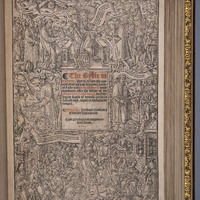
Explore The Exhibition
A National Hero
William Caxton’s reputation took off in the 18th century when antiquarian Joseph Ames brought new focus to his role as England’s first printer. The first major Caxton anniversary took place in 1877, 400 years after his first dated book. It was marked by popular biographies, facsimiles, stained-glass windows and a large exhibition in South Kensington. A century later, Caxton anniversary celebrations took as their starting point his first publication in England in 1476. Exhibitions were held and there was even a thanksgiving service in Westminster Abbey.
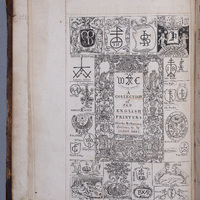
Beyond Caxton
Caxton’s books were produced to resemble the manuscripts known to the reading public. None of them had a title page and all were produced in black letter. Pictures were woodcuts, which allowed little precision. Navigational guidance to readers was limited in the frequent absence of page or leaf numbers, running titles and indexes. Caxton never faced the challenge of printing non-roman scripts or music, although continental printers tackled them during his lifetime. After Caxton’s death these features developed further in England and Europe, and other areas of publishing diversified greatly.
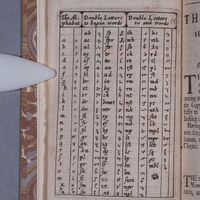
Caxton's English Contemporaries
William Caxton was the first of several printers in England in the 15th century: in Westminster, London, Oxford and St Albans. His most famous contemporaries, and those who lasted for longest, were Wynkyn de Worde and Richard Pynson. Wynkyn de Worde worked in Caxton’s Westminster shop from the outset, and took it over after Caxton’s death. He continued to use Caxton’s device, typefaces and woodcuts. Richard Pynson began to print in 1490. Both men printed some of the same texts as Caxton, while also developing in their own ways. Printers who overlapped with Caxton and were active for shorter periods included Theodoric Rood and Thomas Hunt (Oxford), John Lettou, and William de Machlinia. Of these named printers, Thomas Hunt is the only native Englishman apart from Caxton.
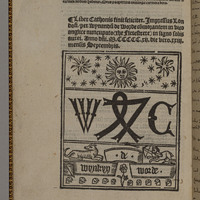
Going Full Circle
The printed book democratised literature because printed books were cheaper than manuscripts. At the same time, the fact that paper and ink were made by hand ensured high quality. Caxton did not aim to produce beautiful books as some Continental printers did. However, in his Malory he uses woodcut initials for the first time, a feature which was decorative as well as functional.
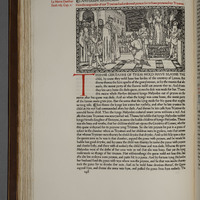
The first major change in book production after Caxton was the mechanisation of all aspects of the printing process in the nineteenth century. Books became very much more affordable, but it was impossible to maintain both low price and high quality. The private press movement instigated by William Morris in the 1890s restored hand production and high quality but at a financial cost; one could not have both.
William Caxton printed Sir Thomas Malory’s Morte Darthur in 1485. His version remained the only one known until the Winchester manuscript was rediscovered in 1934.
The Beginnings
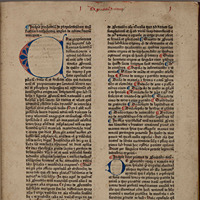
The transition from manuscript to print was gradual. The earliest printed books imitated the manuscripts with which readers were familiar. They often included manuscript elements like paragraph marks and capital letters. As in manuscripts, words could be abbreviated. All the printed books featured in this section had been popular in manuscript: Caxton and other publishers had to be confident of sales in order to recoup their investment, and printing known bestsellers was a safe procedure.
The Power of Print
Print reshaped how people encountered faith, history, news, crime, politics, science and language. These books reveal print’s capacity to confer authority, promote official ideologies and mobilise readers across social ranks. State-sponsored works such as the Great Bible and historical compendiums like Holinshed’s Chronicles were officially approved visions of religious belief and English nationhood. Cheaper formats – plays, newsbooks and polemical pamphlets – brought contested ideas to broad audiences. At the same time, large-scale reference works, from herbals to dictionaries, used print to organise and publicise expanding bodies of knowledge.