-
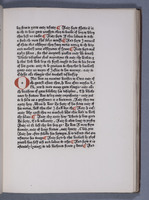 The Dictes and Sayings of the Philosophers
The issue of Caxton’s works in facsimile constituted one of the means to commemorate and spread his output for anniversaries. The London printer and bookseller Elliot Stock led the way with The Dictes and Sayings of the Philosophers in 1877, four hundred years after Caxton first printed the text in Westminster. This was a popular compilation of the sayings of ancient classical, Biblical and legendary philosophers, translated from French into English by Caxton’s patron Anthony Woodville, Earl Rivers.
The facsimile includes a scholarly introduction by the printer and bibliographer William Blades, who had produced a two-volume study of Caxton sixteen years earlier. It is a clearly celebratory text, Blades commencing his preface with the words: “Four hundred years ago, in the year 1477, a great marvel appeared in England, and many of her proudest nobles and wealthiest citizens wended their way to the Almonry at Westminster to see the small wooden printing press which William Caxton had brought from Bruges … and to gaze in wonder at its almost supernatural productions”.
The facsimile includes reproduction of the red initials and paragraph marks from the manuscript from which it was made and a cover design imitating fifteenth-century binding styles. It claims “minutest accuracy” as a fitting tribute to Caxton. Although the anniversary prompted its timing, the facsimile was ultimately produced for the general reason of all facsimiles, to produce at a reasonable price a text which, if available, would be unaffordable for most pockets – in this instance, a fine copy of the original text was estimated in the 1870s at one thousand pounds. In parallel with the production of facsimiles, the Early English Text Society printed several of Caxton’s translations as scholarly editions in the 1870s and 1880s.
Stock followed up this text with facsimiles of the Game of Chesse (1877) and non-Caxton incunable Boke of St Albans (1881). Three facsimiles from the Scolar Press – Malory’s Morte d’Arthur, The Game of Chess, and The History and Fables of Aesop - marked the quartercentenary in 1976 of Caxton’s introduction of print to England.
-
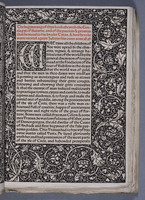 Recuyell of the Historyes of Troye
Caxton’s first translation, and the first book to be printed in English, was Raoul Lefèvre’s fifteenth-century French courtly romance Recuyell of the Historyes of Troye (1474). Using an edition printed by Wynkyn de Worde and borrowed from Quaritch as their copy, the Kelmscott Press issued an edition in November 1892.
William Morris's short-lived but famous Kelmscott Press (1891-1898) fuelled late-Victorian enthusiasm for Caxton. In a way it reflected Caxton: in A Short History of English Printing, 1476-1898, the bibliographer Henry Plomer described the career of the Kelmscott Press as the culminating episode in a story that started with Caxton in 1476. ‘Caxton’s books’ had been William Morris’s immediate response to what to print at the Kelmscott Press. Ultimately five of the Press’s 53 titles were Caxtons: The Golden Legend and The Recuyell of the Historyes of Troye (1892) and The Order of Chivalry, Reynard the Fox, and The History Of Godefrey Of Boloyne (1893). Morris’s interest in Caxton at the Kelmscott Press pertained entirely to content. Morris had replicated Caxton’s fourth type in The Story of Gunnlaug the Worm-Tongue (privately printed at the Chiswick Press, 1891), but Caxton’s books were not aesthetically appealing, and Morris drew his typographical inspiration from such fifteenth-century German printers as Peter Schoeffer, Anton Koberger and Günther Zainer.
This particular response to Caxton was for connoisseurs. The Recuyell was printed in 305 copies. The 300 paper copies cost nine guineas each, the five on vellum vellum, eighty pounds.
-
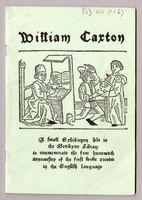 William Caxton
Commemorations for the 500th anniversary of English printing in the twentieth century resembled to a large extent those for the 400th anniversary in the nineteenth century. The year of celebration moved forward from 77 to 76, to commemorate the first printing in England as opposed to the first dated book. An opportunistic glut of publication appeared, some with ‘quincentenary’ in the title. Among the new books were three facsimiles of Caxton publications from the Scolar Press (Malory’s Morte Darthur, The Game of Chess, and Aesop), several biographies, and the appearance in Puffin of Cynthia Harnett’s The Load of Unicorn, a children’s book about Caxton and the resistance of scriveners to print. Westminster Abbey hosted a thanksgiving celebration, and Royal Mail issued a set of four commemorative stamps. Libraries across the United Kingdom held exhibitions: those privileged to hold editions by Caxton, such as the British Library, Cambridge and Glasgow University Libraries, and the John Rylands Library in Manchester, and some which did not (Manchester Polytechnic, now Manchester Metropolitan University).
The booklet shown is from the exhibition held at the Bodleian Library in Oxford in 1975. It notes the conscious collecting of editions by Caxton by the antiquarian John Selden (1584-1654) in the first half of the seventeenth century and it retains the sense of national identity evident in the quartercentenary celebrations: "The fact that England was one of the few countries in Europe to which printing was first introduced by one of her own native craftsmen, will always be a matter of pride and interest to Caxton’s fellow-countrymen".
-
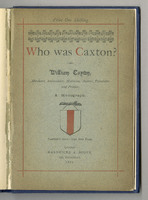 Who was Caxton?
Caxton became known as the founding father of English printing and a national hero in the nineteenth century, as printing and publishing became more widely valued. The first large commemoration of Caxton took place in 1877, four hundred years after Caxton’s first dated book in Westminster, The Dictes and Sayings of the Philosophers. Stained glass windows recalled Caxton pictorially. An exhibition of the overview of the development on printing in England, commemorated permanently by its catalogue, was held in South Kensington.
Many less prominent publications appeared. Elliot Stock produced a facsimile edition of The Dictes and Sayings of the Philosophers, with an introduction describing Caxton’s printing press as ‘a great marvel’, with ‘almost supernatural productions’ at which the cream of London society gazed in wonder. Biographies appeared or were reissued, most significantly typographer William Blades’s one-volume abridgement of his two-volume Life and Typography of William Caxton (1861-1863) as The Biography and Typography of William Caxton. The 47-page booklet featured here derives from William Blades’s work. Costing one shilling, it is one of several small publications targeting a wide audience. It states its purposes in nationalistic terms:
"In consequence of the Caxton Celebration being held this year, and the Caxton Exhibition being in full progress at South Kensington, the question is frequently asked: 'Who was Caxton?' It is hoped that the present slight sketch will give, in a cheap form, a sufficiently accurate and satisfactory account of one who was so great a benefactor to the English race."
The booklet makes clear that Caxton’s greatness arises to a large extent from the culture that arose through the technological innovation of printing: "Although Caxton, as the pioneer in England of the printing art, will ever be entitled to the undying gratitude of his country, his name will also be remembered as having been the principal agent in lifting English literature from its low position, and fostering the growth of a purer taste among his countrymen, which blossomed out during the following century in the greatest poets and writers the world has ever seen".
-
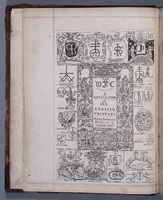 Typographical Antiquities
William Caxton remained a nonentity for almost 300 years after his death. Attention was drawn to him by Conyers Middleton’s 29-page Dissertation concerning the Origin of Printing in England (1735) and John Lewis’s biography of Caxton of 1737. Typographical Antiquities (1749), by the antiquary Joseph Ames (1689-1759), was a seminal record of printing in England and Caxton’s place in it. Ames covered English printing up until 1600. He devoted far more space to Caxton (75 pages) than to any other printer discussed. Ames listed Caxton’s books and transcribed his prologues and epilogues. Importantly, he was the first bibliographer to reproduce Caxton’s typefaces and to date books by the type used.
Ames emphasised print as a means of communication. He followed Reformation authors in describing printing as a ‘divine art’, pointing out the prohibitive prices of books before the printing revolution. He further wrote about the changes printing brought about:
"And I am perswaded, if any one would be at the trouble to compare the present body of our people, in regard to literature and their capacities in affairs, with those of our ancestors, who flourished 300 years ago, when there was no printing, they will readily acknowledge, that this curious art hath not a little contributed to the benefit and improvement of mankind."
Caxton emerges as a patriot, who practised printing abroad and brought it to England, "being desirous of his country’s good’"