-
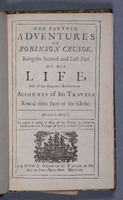 The Farther Adventures of Robinson Crusoe
Caxton printed a number of entertaining works, even when he badged them as educational. These include romances like Geoffroy de la Tour-Landry’s The Knight of the Tower and the Four Sons of Aymon alongside works by Chaucer, John Lydgate, and Thomas Hoccleve. Had novels existed in the fifteenth century, Caxton would certainly have printed them. However, the genre of novels developed only much later. The first novel is generally thought to be Miguel de Cervantes’ Don Quixote (1605-1615; translated into English 1612-1620). Robinson Crusoe (1719) is one of the contenders for the status of being the first native English novel.
The Farther Adventures of Robinson Crusoe (also 1719) is shown here both as an example of a genre which postdates Caxton and for its demonstration of typographical features unknown to Caxton. The map facing the first page is engraved. Engraving as a form of illustration, albeit known on the Continent in the fifteenth century, did not become widespread until the mid-sixteenth century. The earliest English book to contain an engraving is John Stanbridge’s Accidence, printed by Richard Pynson in about 1505, and English printers relied almost entirely on woodcuts for their illustrations until about 1535. Specially designed decorative headpieces marking the beginning of sections of a work, as here, first appeared in about 1570. While Caxton used decorative printed initials in his edition of Malory’s Arthuriad in 1485, the factotum initial (a standard piece of type in a decorative surround) did not enter print in England until about 1551.
-
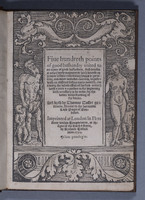 Fiue Hundreth Points of Good Husbandry
Agricultural works circulated in England – a rural economy - before the invention of print: the thirteenth century saw the appearance both of Robert Grosseteste’s Les Reules Seynt Roberd (before 1253) on estate management and of Walter of Henley’s slim Le Dite de Hosebondrie (about 1280). But William Caxton’s output included nothing on agriculture, nor indeed on practical knowledge in general, and the first record of a printed agricultural book in England is Boke of Husbandry, a translation of Walter of Henley printed by Wynkyn de Worde in about 1508. In the sixteenth century works on agriculture were popular as practical tools for landowners. John Fitzherbert’s Book of Husbandry appeared in at least twenty editions between 1523 and 1598. Thomas Tusser’s Hundreth Good Pointes of Husbandrie first appeared in 1557 and was expanded in 1573 to Fiue Hundreth Points of Good Husbandry. Tusser’s commonsense approach, expressed in verse, appealed, and the book ran through eleven reprints in the sixteenth century.
-
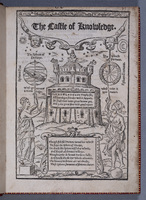 The Castle of Knowledge
Mathematics and astronomical works circulated in manuscript before the introduction of printing by movable type, and several continental incunabula deal with the subjects. England was different: Caxton’s only nod to the subjects in his Westminster output was in his encyclopaedic Myrrour of the Worlde (1481 and about 1489-90). Robert Record’s Castle of Knowledge (1556), a mathematical account of the sphere, was the first clear scientific description in English of elements of astronomy. The subject matter was highly relevant for mariners and for merchants trading abroad, and Record sought to make it accessible by writing in dialogue form in English.
The book is also quite innovative typographically. Although set largely in the black letter type that was common for vernacular books at the time, it uses bits of roman and italic type unknown to Caxton. Richard Pynson introduced roman type to England in 1509 in his editions of Pietro Griffi’s Oratio and Girolamo Savonarola’s Sermo. Wynkyn de Worde introduced italic type to England in two Latin works in 1528. Reynold Wolfe, the printer of this book, was the first to use italic in an English book, Record’s Pathway to Knowledge (1551).
-
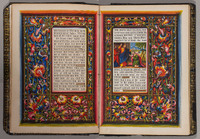 The Miracles of our Lord
In Caxton’s time and into the nineteenth century, book illustrations were coloured mainly by hand. Chromolithography, patented in 1837, was a tremendous leap forward. It was a form of the new technique of lithography (invented in Germany in 1796, and used in England by 1801), which involved applying grease to a flat stone or metal plate: ink would adhere to the greasy areas and be repelled by the rest of the surface. Chromolithography typically used between four and twelve colours. Straightforward for artists and suitable for high-speed reproduction, it was perfect for books which wanted to replicate illuminated manuscripts and required colour throughout.
Miracles of our Lord presents twelve Gospel stories. The subject matter harks back to The Golden Legend, which Caxton published 1483/4 and which includes incidents from the life of Christ.
-
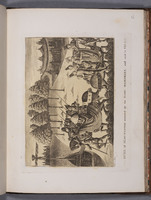 Sir John Froissart's Chronicles of England, France, Spain, and the Adjoining Countries
This book shows the use of aquatint: a method of illustration which developed in France in the eighteenth century. The artist Paul Sandby made it fashionable in Great Britain in the 1770s, as a medium for topographical illustration. The technique reached its peak in works published by Rudolf Ackermann in the early nineteenth century.
Aquatint is an intaglio process like etching, but instead of applying a needle to make lines, it uses powdered rosin on a copper plate to create varied tones as in wash drawings. Watercolour is applied by hand after the aquatint has been printed.
Chronicles had been popular since the early Middle Ages, and William Caxton printed three titles in four editions: two editions of the Chronicles of England (1480 and 1482) and one each of Ranulphus Higden’s Polychronicon (1482) and its derivative Description of Britain (1480). Froissart’s chronicles first appeared in England in English translation in 1523.
-
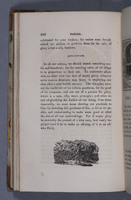 Fables of Aesop and Others
The illustrative technique shown here postdates Caxton by three centuries. Thomas Bewick developed the art of wood engraving in the late eighteenth century. Wood engravings combined the best of woodcuts and metal engravings. They were made by cutting into the end-grain of hard wood with the burin used for copper engraving, enabling much more detailed images than could be obtained by woodcuts. But whereas copper engraving had to be printed separately from type, wood engravings had the advantage that they could be printed at the same pull of the press.
William Caxton was Aesop’s first translator into English. He translated the fables from an intermediary French translation and printed them twice, both times as folios with woodcut illustrations, in 1484 and again in the 1490s.
-
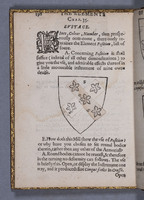 The Elements of Armories
Today we associate interactive, movable books primarily with books for young children, with flaps to lift or tabs to pull. Such interactivity is, however, a mediaeval concept. Volvelles are turning wheels: pieces of paper which are fastened to a leaf and can be rotated on it. Ramon Lull used them in his thirteenth-century manuscripts, and the first printed volvelle appeared in Johannes Regoimontanus’ Calendarium (Nuremberg, 1474; see [Incunabula] 12). Particularly famous sixteenth-century examples appear in Peter Apian’s Cosmographia (1524) and in Astronomicum Caesarium (1540). Caxton and his English contemporaries did not use volvelles, and Edmund Bolton’s The Elements of Armories (1610) is the first English book to do so. It is unusual in putting volvelles to heraldic use, to show how to design a coat of arms.
Heraldry had been popular since the Middle Ages. Caxton showed interest in the wider area of chivalry through his translations Ordre of Chyvalry or Knyghthode (1484, from Ramon Lull’s Libre del orde de cavayleria) and Fayts and Arms of Chivalry (1489, from Christine de Pisan’s Faits d'armes et de chevalerie).
-
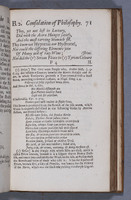 Of the Consolation of Philosophy
William Caxton printed Boethius’s De Consolatione Philosophae (The Consolation of Philosophy) in about 1478, in Latin and in Geoffrey Chaucer’s English translation. It appeared independently in English translation surprisingly few times in the next two centuries This edition was translated and edited by Richard Graham, 1st Viscount Preston. It is shown here for its multiple footnotes. Glossing was a feature of mediaeval manuscripts which continued into print both as extended glosses surrounding text and as side and shoulder notes. Caxton used printed marginalia in both his editions of the Speculum vitae Christi (‘Mirror of the Life of Christ’, 1484 and about 1489-90). However, notes at the bottom of pages did not appear until the seventeenth century. They entered the Netherlands in the first half of the seventeenth century and were first used in other countries, including England, from the 1680s onwards. They became common in the eighteenth century and are now ubiquitous.
-
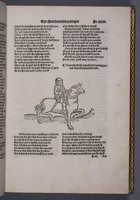 The workes of Geffray Chaucer
Caxton published several editions of Chaucer’s works: The Canterbury Tales twice (about 1476-77 and 1483), and Chaucer’s Boethius, The Parlement of Foules, The Book of Fame, Troilus and Criseyde, and Queen Anelida and the False Arcite once each. He thereby helped to promote English language and literature and set Chaucer on the way to becoming the ‘father of English poetry’. Not until 1532, however, did a collected edition of Chaucer’s output appear. This edition by William Thynne (d. 1546) distances itself from Caxton’s text, deploring Caxton’s ‘many errours, falsities and deprauacions’ and emending the language. Thynne adds some Chaucerian pieces not printed before and adds a biography and genealogy of Chaucer.
Elements of the layout – running title, foliation, catchword, and signatures – show how books developed to help printers, binders and readers to navigate them. This book is foliated (that is, each leaf is numbered). It has a running title at the top of each page, a catchword (the first syllable or word of the following page) at the bottom, and signatures indicating how the sheets making up the book were put together at the bottom of the first half of each gathering: all features which are to be expected by this time. By contrast, Caxton only ever signed the first leaf of each gathering, and he did not foliate his books. Caxton first used running titles (which existed in twelfth-century manuscripts but appeared spasmodically in early printing) in his Polychronicon of 1482, and used them only in his larger works – admittedly including his second edition of The Canterbury Tales. Both Pynson and Wynkyn de Worde signed books to the centre fold, foliated them, and used running titles. Catchwords did not appear in English books before the sixteenth century.
-
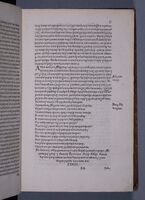 Aelfredi Regis Res Gestae
Fonts in England in the incunable period were required purely to deal with common languages: English, Latin, law French. Other fonts came much later: when Wynkyn de Worde wanted to print scraps of Greek, Hebrew and Arabic in Robert Wakefield’s Oratio de laudibus trium linguarum (1528), he did so by inserting the words as woodcut blocks. The first book printed in England to use a Greek font was published in 1543 (John Chrysostom’s Tou en hagiois Iōannou tou Chrysostomou homiliai duo); the first to use a Hebrew font in 1656 (Safer tehilim usafer eykhah sepher tehillim u-sepher echam = the Hebrew Text of the Psalmes and Lamentations).
The first text to include an Anglo-Saxon font was published in 1566; this biography of King Alfred by the ninth-century Welsh bishop and scholar John Asser (d. 909) is the third. The font was financed by Matthew Parker, Archbishop of Canterbury. It was designed by Parker’s Latin secretary John Joscelyn (1529-1603) to resemble the writing of Old English manuscripts. It represents antiquity, authority, and authenticity. The desire for an Anglo-Saxon font came about with the English Reformatory zeal to prove the ancientness, and hence validity, of the English church, in an example of print being used for religious propaganda.
-
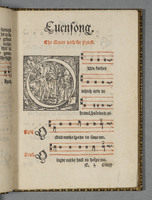 The Booke of Common Praier Noted
Printing music was a major challenge. Caxton did not do it. When he wanted to reproduce musical notes in his 1482 edition of Ranulphus Higden’s Polycronicon, he left a space for the notes to be supplied in manuscript, as did all the earliest printers. Starting in the 1490s and continuing throughout the sixteenth century printers, including Wynkyn de Worde and Richard Pynson, printed each note individually with rules for the stave extending from it. The rules seldom aligned perfectly. The other early method was to do what Richard Grafton, the printer of this prayer book did: to push each sheet through the printing press twice, once for the staves and once for the notes. This was more time-consuming and hence more expensive. Later music was usually engraved. The successful printing of music was achieved only with the introduction of lithography in the late eighteenth century.
-
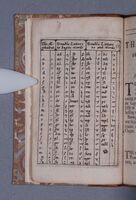 The Art of Short-Writing according to Tachy-Graphy
The printing that Caxton practised in England was a simple matter of letters, numerals and woodcuts. Some features not used by Caxton came to England in the sixteenth century, having been used on the Continent in the fifteenth. Other challenges were hard to solve. These included the reproduction of shorthand symbols, a technique which was not mastered until lithography was introduced in the late eighteenth century. Until then, the options to cope with shorthand were either to print books with blank spaces for the symbols to be added by hand, or, as here, to engrave pages.
The book shown is by the seventeenth-century stenographer Thomas Shelton, who taught shorthand in London and created his own system. The first shorthand manual to be printed in England, or anywhere, was Timothie Bright’s Characterie, published by John Windet in 1588.