-
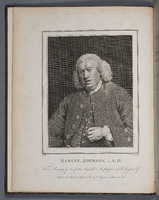 A Dictionary of the English Language, 6th edn
Although not the first dictionary in English, Samuel Johnson’s Dictionary of the English Language became the most influential English dictionary of the eighteenth century. First published in 1755 after nearly a decade of labour, it contained over 40,000 definitions and approximately 114,000 illustrative quotations drawn from authors including William Shakespeare, John Milton, and John Dryden.
Johnson’s Dictionary helped codify English at a national scale during a period when questions of linguistic correctness, refinement, and literary authority were increasingly important. Rather than merely listing words, Johnson illustrated their meanings through quotations from respected authors, linking the authority of the language to the authority of print and literary culture. His definitions are also notable for their wit, individuality, and occasional political or moral commentary.
The Dictionary was a major commercial and scholarly undertaking. Large folio editions were expensive works aimed initially at institutional and affluent readers, though abridged versions later widened access considerably. Through repeated editions and extensive circulation, Johnson’s work shaped English education, publishing, and lexicography for generations.
-
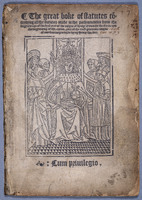 The Great Boke of Statutes
 gathered together parliamentary legislation from the reign of Edward III to that of Henry VIII. By bringing decades of statute law into a single printed volume, books such as this changed how English law circulated and was consulted. Laws that had once existed primarily in scattered manuscript copies could now be reproduced in larger numbers, standardised, and more readily consulted by lawyers, civic officials, and administrators across the kingdom.
The growth of printed statute books coincided with the expansion of Tudor government and the increasing use of parliament to enact religious and political change. Under Henry VIII, legislation played a central role in establishing royal supremacy over the Church of England and authorising the dissolution of the monasteries. Print gave these acts greater visibility, helping project royal policy throughout the realm.
The title-page woodcut reinforces this connection between print, law, and monarchy. The enthroned ruler is presented as the source of justice and legal authority, linking statute law to dynastic power and political order. The printed statute book was therefore more than a practical legal reference: it was also a visible expression of Tudor governance and the expanding authority of the state.
-
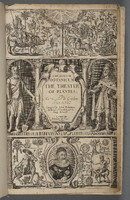 Theatrum Botanicum
John Parkinson’s Theatrum Botanicum of 1640 was the most extensive English herbal of the seventeenth century. Spanning more than 1600 pages and illustrated with approximately 3800 woodcuts, it attempted to gather together contemporary botanical knowledge into a single monumental reference work. Parkinson, who served as apothecary to Charles I, combined medical, horticultural, and descriptive information about plants cultivated in England and abroad.
The work reflects the growing role of print in organising and disseminating knowledge during the early modern period. Large printed herbals enabled information about plants, remedies, and cultivation techniques to circulate far more widely than manuscript collections or oral instruction alone. The numerous illustrations assisted readers in identifying species and demonstrate the importance of visual as well as textual information in scientific publishing.
Theatrum Botanicum also records England’s expanding engagement with global trade and colonial enterprise. Parkinson includes plants newly introduced into Europe through overseas exploration and commerce, among them the pineapple. Botanical works such as this were therefore connected not only to medicine and natural philosophy but also to imperial expansion and commercial exchange. By gathering together diverse forms of plant knowledge in durable printed form, the book exemplifies the role of print in the consolidation these activities.
-
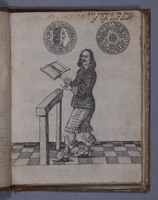 The Triall of Lieut. Collonell John Lilburne
Published in the year of the execution of Charles I, The Triall of Lieut. Collonell John Lilburne publicised the prosecution and eventual acquittal of the radical political activist John Lilburne for high treason. A leading figure among the Levellers, Lilburne argued for legal equality, parliamentary reform, and the rights of ordinary English subjects. Printed accounts of his trial transformed courtroom proceedings into a public political event, enabling readers far beyond London to follow and debate the case.
The illustration shows Lilburne reading from a printed commentary on the laws of England during his trial. The image captures the printed book’s power to authorise political argument and mobilise resistance to authority, presenting legal knowledge as something that could be consulted, cited, and contested outside traditional institutions of power.
Cheap pamphlets and trial accounts such as this helped disseminate radical political ideas during the Civil War and Interregnum periods, contributing to an increasingly participatory print culture in which political debate extended well beyond parliament and court.
-
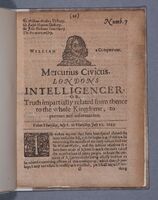 Mercurius Civicus, Londons Intelligencer
During the English Civil War, printed news became a regular and rapidly expanding feature of political life. Newsbooks such as Mercurius Civicus, published weekly between 1643 and 1646, supplied readers with reports on military campaigns, parliamentary proceedings, foreign affairs, and events within London itself. Supporting the Parliamentarian cause, Mercurius Civicus formed part of an intensely competitive print culture in which rival royalist and parliamentarian publications sought to shape public understanding of the conflict as it unfolded.
The breakdown of pre-war censorship and licensing controls contributed to an extraordinary growth in cheap print during the 1640s. This enabled news to circulate at an unprecedented rate, while political crisis created a large and eager readership. Newsbooks blended reportage with commentary, rumour, propaganda, and visual material, often presenting highly selective or partisan accounts of events. Their regular appearance also helped establish new habits of serial reading, familiarising readers with the idea of weekly printed news.
Such publications reveal how print became central to political mobilisation and ideological conflict in seventeenth-century England. Pamphlets, petitions, newsbooks, and printed declarations enabled political arguments to circulate far beyond London and Westminster, helping to transform national politics into a matter of public debate.
-
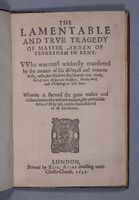 The Lamentable and True Tragedy of Master Arden of Faversham in Kent
Arden of Faversham dramatises the murder of Thomas Arden in Kent in 1550/51 by his wife Alice and several accomplices. The story first reached many readers through Raphael Holinshed’s Chronicles of England, Scotland and Ireland (1577). The play subsequently transformed this recent and widely discussed crime into material for commercial entertainment and moral reflection. It belongs to the genre now known as domestic tragedy, which brought sensational crimes involving ordinary households onto the public stage.
Print played a crucial role in expanding the reach of the story. Alongside theatrical performance, quarto editions such as this one helped circulate the narrative to readers, while ballads, pamphlets, and news reports amplified public fascination with the case. The murder became one of the best-known crimes of the Elizabethan period, illustrating how print could turn individual acts of violence into shared cultural events.
The work also reflects contemporary anxieties about gender, household order, and social stability. Alice Arden’s role in orchestrating the murder challenged assumptions about obedience and patriarchal authority, themes that made the story especially compelling to early modern audiences. Although anonymous, the play has long attracted scholarly interest because of its literary quality and possible connections to William Shakespeare and other dramatists. Whatever its authorship, the text demonstrates how print culture helped establish crime as a profitable and recognisable genre long before the emergence of modern journalism.
-
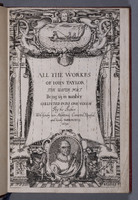 All the Workes of Iohn Taylor the Water-Poet
John Taylor, known as the ‘Water-Poet’, built his literary reputation through print. Originally a labouring-class Thames boatman, Taylor became one of the most prolific and recognisable writers of early seventeenth-century England, publishing poems, pamphlets, travel narratives, satire, and polemical works aimed at a broad readership.
This imposing folio edition of Taylor’s collected Workes, published in 1630, gathers together a remarkable range of material previously issued in smaller and more ephemeral formats. By assembling these writings into a substantial collected volume, Taylor sought to secure literary permanence and social legitimacy. The folio format associated his work with more prestigious scholarly and literary publications, elevating texts that had often first appeared as cheap pamphlets.
Taylor was acutely aware of the commercial possibilities of print culture. His writings frequently reflect on authorship, publicity, and the ability of print to preserve a writer’s name beyond death. He promoted his own publications energetically, financing some of his works by using forms of advance subscription. His career therefore illustrates the increasingly dynamic literary marketplace of seventeenth-century London, where print enabled writers outside traditional elite or courtly circles to achieve visibility and influence.
-
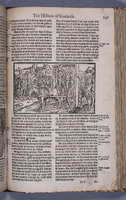 Chronicles of England, Scotland and Ireland
Raphael Holinshed’s Chronicles of England, Scotland and Ireland was one of the most ambitious historical compilations produced in sixteenth-century England. First published in 1577, the work drew together material from chronicles, civic records, earlier printed histories, and eyewitness testimony to create a sweeping account of British history from antiquity to the Tudor present. Its scale and authority made it one of the most influential historical works of the Elizabethan period.
The Chronicles helped shape ideas of English national identity at a moment of religious and political consolidation under Elizabeth I. Although often presented as unmediated historical record, the work reflects assumptions and political values aligned with the Tudor regime, particularly in its treatment of monarchy, rebellion, and providential history. Print gave these narratives a reach and permanence that manuscript chronicles could rarely achieve.
The work also demonstrates the collaborative nature of large-scale printing projects. Holinshed himself acted primarily as compiler and editor, working with other contributors including William Harrison and Richard Stanyhurst, amongst others. The resulting folio volumes were substantial and expensive books aimed at educated and affluent readers. Its influence nevertheless extended far beyond their immediate purchasers. Writers including William Shakespeare drew extensively on the Chronicles for plots, characters, and historical detail. Shakespeare’s Macbeth, King Lear, and several of the history plays all owe significant debts to Holinshed’s narratives.
-
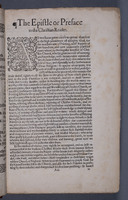 The whole Workes of W. Tyndall, Iohn Frith, and Doct. Barnes
This volume is the first collected edition of the writings of the Protestant reformers and martyrs William Tyndale, John Frith, and Robert Barnes. Edited by the Protestant martyrologist John Foxe and printed by the prominent London printer John Day in 1573, the collection sought both to preserve the writings of early English reformers and to promote a providential understanding of the English Reformation.
The prefatory material presents printing as a divinely ordained technology capable of spreading true religion and combating error. Foxe describes the printing press not as a vehicle for profit or personal fame, but as an instrument given by God for the advancement of Protestant truth. Such claims were common among English Protestant writers of the sixteenth century, who frequently associated print with the dissemination of vernacular scripture and reformist ideas. In this context, the printed book became more than a container of text: it functioned as evidence of divine favour and English national religious identity.
John Day was among the most important printers of Protestant literature in England, producing not only Foxe’s famous Actes and Monuments but also numerous sermons, Bibles, catechisms, and polemical works. Through publications like these, print helped consolidate Protestant memory by preserving the writings and alleged sufferings of reformers for later generations.
-
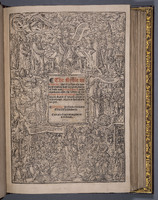 The Byble in Englyshe
In 1538, Thomas Cromwell ordered that every parish church should acquire a copy of the Bible in English and place it where parishioners could read it publicly. This rendered the Great Bible of 1539 the first officially authorised English Bible intended for use in churches across England. The large folio format of the Great Bible reflects this intended communal use.
Produced during the reign of Henry VIII after the break with Rome, the Great Bible formed part of the wider programme of the English Reformation – which sought to establish royal supremacy over the English Church while also making scripture available in the vernacular. The title-page woodcut presents an idealised image of royal authority and controlled religious reform. Henry VIII appears enthroned, distributing the Word of God through bishops and clergy to the people below, visually reinforcing the idea that access to scripture derived from the monarch himself. Yet the text also reveals anxieties about uncontrolled reading and interpretation. The prologue cautions readers against contentious private interpretation, illustrating the tension at the heart of early English Protestantism: while scripture was increasingly accessible in print, its meaning remained something the authorities attempted to regulate carefully.
The printing of the Great Bible was itself an international enterprise. Although it was issued in London by Richard Grafton and Edward Whitchurch, parts of it were printed in Paris before production to be transferred to England. The Bible drew heavily on earlier translations, including William Tyndale’s, whose English New Testament had been condemned only a few years earlier. What had once circulated illicitly in smaller printed editions was now publicly authorised and displayed in parish churches throughout the kingdom.