-
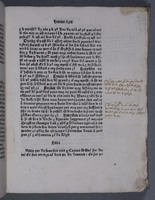 Year Book: 34 Henry VI
William Caxton, Wynkyn de Worde and Richard Pynson were the major English printers/publishers of the incunable period and were those with staying power. They were not the only producers of printed books: in Oxford, St Albans and the London area, a few others came and went. Among these were William Maclyn, or de Machlinia, a native French speaker from Mechelen in Brabant. He worked from 1482 until 1490, initially with Lithuanian-born John Lettou and then alone, in Fleet Bridge and later Holburn. Machlinia specialised in law books in French. Among these were year books: collections of reports of cases brought before the law courts and forming the basis of case law. Such books had been compiled in the manuscript period, and were a mainstay for London publishers specialising in legal printing after that. Richard Pynson took over where Machlinia left off.
-
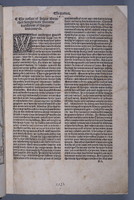 Cronycles of Englande, Fraunce, … and Other Places Adioynynge
Along with William Caxton and Wynkyn de Worde, Richard Pynson (ca 1449-1529/30) is the third in the trio of England’s three major early printers. He started printing in Temple Bar (just outside the boundary of London) 1490, and his first dated work appeared in 1492. In 1501 he moved to Fleet Street, in the City of London. Pynson’s mainstay was legal texts. However, he also issued many texts co-operatively with Wynkyn de Worde (with whom he exchanged woodcuts, borders and type). Like Wynkyn de Worde, he reprinted several texts which had first been issued by Caxton, such as Chaucer’s Canterbury Tales, John Mirk’s Liber festivalis, and the story of Reynard the Fox.
Chronicles had been popular since the early Middle Ages. Those of Jean Froissart (1337-1410) cover France, England and to an extent the neighbouring countries in the period of the Hundred Years War. Henry VIII requested an English translation from John Bourchier (1467-1533), and Pynson, as the King’s printer, was the first person to publish the English version.
-
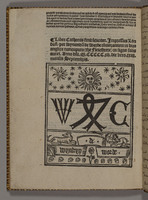 Catho cum Commento
Wynkyn de Worde (d. 1534/5) provides a link between William Caxton and later printers. He was a German-born printer who joined Caxton in Cologne in 1471/2, accompanied him to Bruges (1472), and subsequently worked in Caxton’s shop in Westminster. After Caxton died in 1492, Wynkyn de Worde took over his business, including his device, founts, and woodcuts. In 1500/01 he moved from Westminster to London, where he set up the first print shop in Fleet Street. He later added a shop in St Paul’s Churchyard.
De Worde was more interested than Caxton in typography and illustration. He also moved into new areas of content, including educational texts, mainly by English writers, children’s books, and books on household practice. But some of his publications continued Caxton’s principles, such as English poetry. He also produced tested bestsellers formerly printed by Caxton. Disticha de moribus was a popular Latin textbook attributed to Cato Dionysus, which Caxton printed three times between 1476 and 1483. Catho cum commento thus follows in Caxton’s footsteps.