-
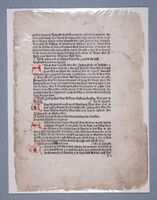 Leaf from The Chronicles of England
Chronicles were popular from the early Middle Ages onwards. The first Chronicles to be printed in England emanated from Caxton’s press, in 1480 and again in 1482. They extend from the supposed settling of Britain by Albinia and Brutus to the year 1461. Caxton knew that the work would have a market, having published it ‘at the request of diverse gentlemen’. Caxton followed Brut’s manuscript chronicle for the time down to 1419. He presumably used civic chronicles and Werner Rolewinck’s Fasciculus temporum when compiling the rest, and he added a table of contents and a concluding prayer. Caxton never followed his sources slavishly, and one of his additions was to expand references made by Rolewinck to the invention of printing.
Typographically, the book is noteworthy as the first English printed book to contain through the arrangement of the table of contents an alphabetical index. It is the first time that Caxton uses line justification and signatures (found on the first page of each quire).
This leaf describes the year in which Henry, duke of Lancaster died, Edward Prince of Wales married the countess of Kent, and John of Gaunt, son of Edward III, was made duke of Lancaster. The leaf is from a leaf book, that is, a single leaf accompanied by an essay. The very fact of its sale thus packaged is a sign of the collectability of Caxton’s output.
-
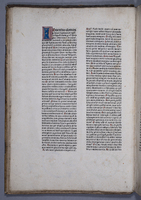 Legenda Aurea
William Caxton produced works already proven to be popular as safe publishing ventures. Salient among these is The Golden Legend, which Caxton translated and issued in 1483/84. It is from the Legenda Aurea, a collection of saints’ lives compiled in about 1260 by the Dominican friar and Bishop of Genoa, Jacobus de Voragine (1228/30-1298). Over one thousand extant manuscripts testify to its place in mediaeval culture. The first printed edition dates from about 1469. Some 150 editions followed during the incunabula period, including translations into French, Dutch, Italian, Spanish, German, Low German and even Czech. Caxton’s translation was an adaptation which added several English saints.
Shown here is the first of six incunable editions issued by Nuremberg’s leading printer and publisher, Anton Koberger (ca 1445-1513). Anton Koberger ran a much larger venture than William Caxton or any other printer, employing 24 presses and more than one hundred workmen when most printers had at most three presses. Yet his career parallels Caxton’s in certain ways: as the outstanding publisher of his country in the fifteenth century; as the producer mainly of folios; as a pioneer (it was Koberger who brought printing to Nuremberg), and as a shrewd businessman.
-
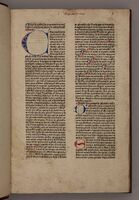 De proprietatibus rerum
William Caxton learned and practised printing in the low countries before moving to Westminster. His very first book is also the longest. It is the editio princeps of De proprietatibus rerum (‘On the properties of things’), produced in Cologne in 1471. The work was an essential source of information for readers throughout Europe. It is a mediaeval encyclopaedia, thought to have been written in the 1240s by the Oxford graduate and Franciscan friar Bartholomaeus Anglicus (‘Bartholomew the Englishman’). Its nineteen sections cover theology, philosophy, medicine, astronomy, chronology, and the natural sciences from botany through to mineralogy, thereby moving from God to man to lesser orders of being, in the standard hierarchy of the time. Bartholomaeus Anglicus wrote it to help his fellow Franciscans to general knowledge without their having to become expert in each discipline. Manuscripts of the book circulated widely, both in the original Latin and in translation. It was therefore an obvious candidate for printing, as a certain bestseller. The fact that Caxton chose to produce the book in the original Latin indicates a continental consumer group.
Caxton’s name is not mentioned in the book, and we know about his involvement only because Wynkyn de Worde tells us of it in his edition of John Trevisa’s fourteenth-century English translation (about 1496). Caxton’s major contribution to the book was to finance it. While he may have assisted with the printing, the main printer was Johan Veldener, a German who was also a typecutter and who supplied Caxton with his first three types.
Note the ‘Lombardic’ initials and the paragraph marks in manuscript, which show the transition from manuscript to print in hybrid books which were finished by rubricators, and show how incunabula were made to look like the manuscripts from which they evolved. The type is based on the forms of script used in Cologne monasteries.
-
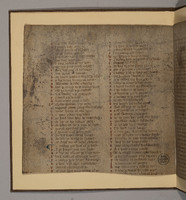 Manuscript fragment of Kyng Alisaunder
Printing did not enter England in a literary vacuum. Literary, historical, theological and scientific manuscripts abounded before Caxton; what printing did was to broaden and cheapen circulation. This sheet is from the Auchinleck manuscript, a Middle English manuscript produced by commercial scribes in London in the 1330s. The entire manuscript contains works of various genres, from saints’ lives and legends to a bawdy fabliau. It is most famous for the romances it contains, and this sample is part of a verse romance about Alexander the Great.
The Gothic script (textualis) and the blue and red paragraph marks which assist readers to navigate the text are features which were carried over from manuscripts into incunabula, to give the new technology a familiar appearance.
-
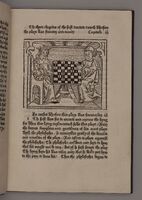 The Game of Chess
De ludo scachorum (‘The Game of Chess’) was a popular moral text by the Italian Dominican friar Jacobus de Cessolis (ca 1250-ca 1322). It was a treatise on social classes and the duties of the nobility, in which the chess pieces, their shapes, their positions and their moves represent human society. The work circulated widely in manuscript before making its first printed appearance in Utrecht in 1474. Sixteen Latin and vernacular editions followed in the fifteenth century. Translations were into Italian, German and Dutch as well as English.
William Caxton translated the work into English from two mid-fourteenth-century French translations, by Jean de Vignay and Jean Ferron respectively. His first English edition appeared in Bruges or Ghent in March 1474 and was the first in any language to appear after the Utrecht one. Caxton wrote that the work sold because it was ‘full of wholesome wisdom and requisite unto every state and degree’. It was one of three allegorical works of moral guidance that he published.
Caxton dedicated his first, unillustrated, edition to George, Duke of Clarence (1449-1478; Edward IV’s brother). Shown here is Caxton’s second edition, from 1483. By then the Duke of Clarence had been imprisoned in the Tower of London for high treason and had died there, so Caxton accordingly excised him from the preface. He also amended the list of contents for greater conformity with chapter headings and added woodcut illustrations - still a novelty in 1483, although Caxton had introduced woodcuts into his books in 1481 in his Mirror of the World. The book contains 24 illustrations, one per chapter, from 16 cuts. Gaps are left for initials to be added by hand.
Senate House Library is one of 14 holding institutions.