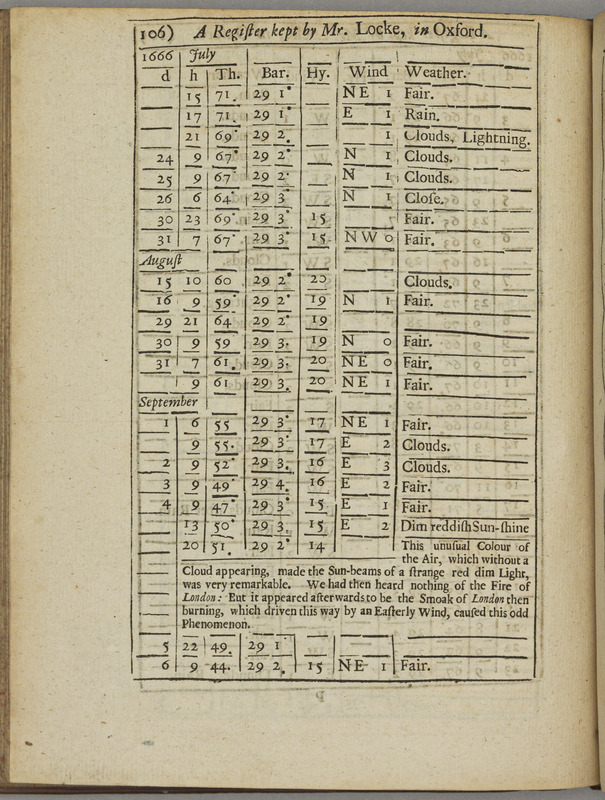
Standardised weather diaries were the answer to weather's elusiveness for the 17th century thinkers who embraced the experimental scientific method according to which data recording and analysis was essential for acquiring knowledge. One of the first modern chemists Robert Boyle persuaded his friend and fellow empiricist philosopher John Locke to start a weather diary in June 1666 with consistent recordings of atmospheric measurements such as temperature and pressure. On 4 September, Locke observed a “dim reddish sunshine” in Oxford, unknowingly describing the effects of the devastating Great Fire of London, which had started two days earlier.
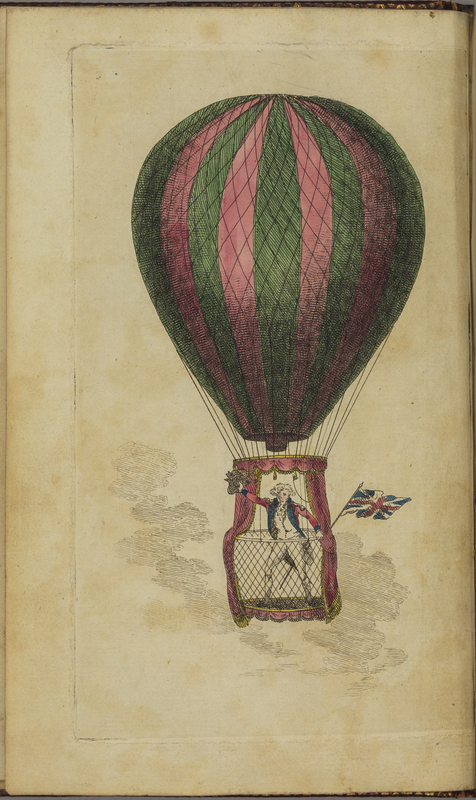
An account of five aerial voyages in Scotland : in a series of letters to his guardian, Chevalier Gerardo Compagni, written under the impression of the various events that affected the undertaking / by Vincent Lunardi. Lunardi, Vincent, 1759-1806. BOOK | Printed for the author, and sold by J. Bell | 1786 !ocr!
Illustrations from A treatise on forming, improving, and managing country residences : and on the choice of situations appropriate to every class of purchasers, in all which the object in view is to unite in a better manner than has hitherto been done, a taste founded in nature with economy and utility, in constructing or improving mansions, and other rural buildings, so as to combine architectural fitness with picturesque effect, and in forming gardens, orchards, farms, parks, pleasure grounds, shrubberies, all kinds of useful or decorative plantations, and every object of convenience or beauty peculiar to country seats, according to the extent, character, or style of situations, and the rank, fortune, and expenditure of proprietors, from the cottage to the palace : with an appendix, containing an enquiry into the utility and merits of Mr. Repton's mode of shewing effects by slides and sketches, and strictures on his opinions and practice in landscape gardening / by John Loudon (London : Printed for Longman, Hurst, Rees, and Orme, by C. Whittingham, 1806).
Etching from Richard S. Chattock, The Black Country: sixteen etchings illustrative of scenes in the coal and iron district of South Staffordshire : With descriptive letterpress to each plate, etc. (London ; Birmingham, [1878]).
Map from Great Western Railway, Through the window. No.1, Paddington to Penzance (Cornish Riviera route) : 300 miles of English country as seen from the G.W.R. trains (1924 [London] : Great Western Railway).
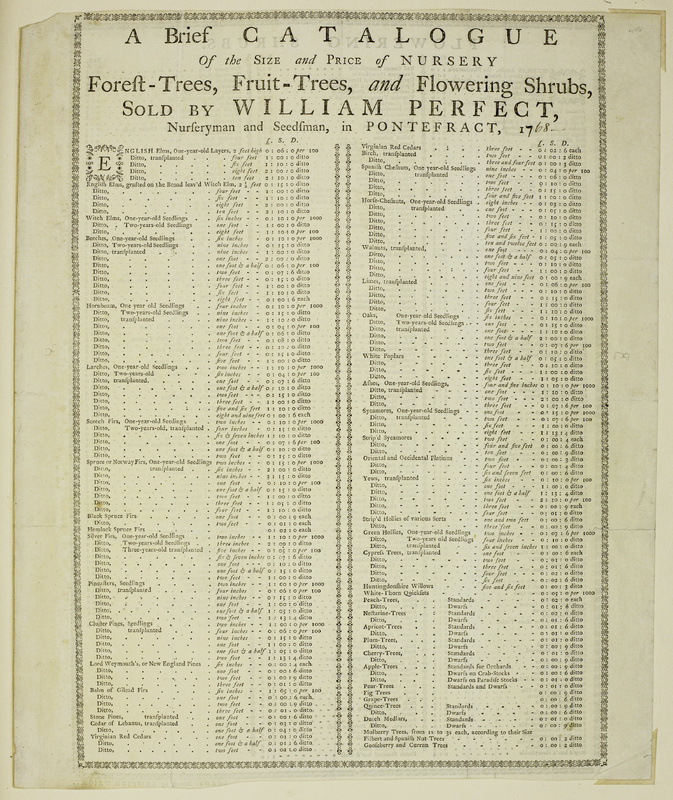
William and John Perfect (Firm), A brief catalogue of the size and price of nursery forest-trees, fruit-trees, and flowering shrubs, sold by William and John Perfect, nurserymen and seedsmen, in Pontefract, 1774 ([York : printed by C. Etherington, 1774]). ULL copy is in a volume of broadsides bound in modern half leather; each item mounted on hand-made paper.
Published by William Clowes and Sons for the Executive Council of the International Health Exhibition, and for the Council of the Society of Arts, 1884 [G.L.] B.884 [International] The Royal Meteorological Society’s participation in the International Health Exhibition of 1884 reaffirmed the understanding of the interrelation of health and weather. Besides weather forecasting, the Society set up 82 climatological stations, as shown in this chart, in order to to understand the health implications of different weather conditions, including moisture levels in English seaside towns. The Society also encouraged public participation by displaying a model of a climatological station on the Exhibition’s grounds for “those desirous of organising a station”.
Second edition, W. Phillips London, 1833 [G.L.] 1833 The diagram visualises the cycle of temperature variations in London throughout the year. Amateur meteorologist Luke Howard had a life-long fascination with studying the weather. His passion was sparked by the summer haze of 1783, caused by a volcano eruption in Iceland. Based on Howard’s meticulous long-term observations, The Climate of London broke new ground. It was the first study to document the effect of air pollution on urban climate.
Author Sprat, Thomas, 1635-1713. TitleThe history of the Royal Society of London, : for the improving of natural knowledge. / by Tho. Sprat, ... ImprintLondon : printed for J. Knapton, J. Walthoe, B. and S. Tooke, D. Midwinter, B. Cowse, J. Tonson, R. Robinson, J. Wilford, and S. Chapman, 1722. Descript.[16], 438p, [2] folded leaves of plates : ill ; 23cm ; 4̊. Pag. 173-
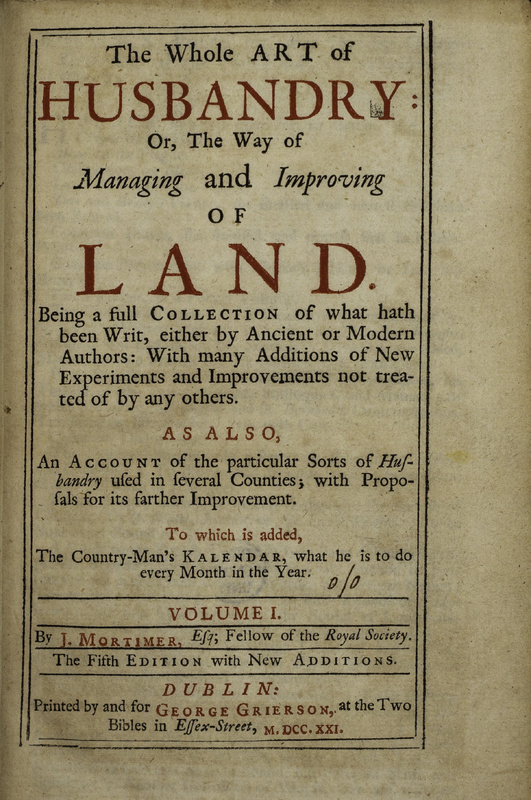
The whole art of husbandry, or, The way of managing and improving of land : being a full collection of what hath been writ, either by ancient or modern authors ... ; as also an account of the particular sorts of husbandry used in several counties ... ; to which is added the country-man's kalendar / by J. Mortimer (Dublin : Printed by and for George Grierson, 1721). The fifth edition, with new additions.
The lady's recreation, or, The third and last part of the art of gardening improv'd / by Charles Evelyn ... : to which are added some curious observations concerning variegated greens by the Reverend Mr. Laurence (London : Printed for J. Roberts, 1717).
The fruit-garden kalendar, or, A summary of the art of managing the fruit-garden : teaching in order of time what is to be done therein every month in the year : containing several new and plain directions more particularly relating to the vine : to which is added an appendix of the usefulness of the barometer, with some short directions how to make a right judgment of the weather / by John Laurence (London : Printed for Bernard Lintot, 1718).
Diagram from The manner of raising, ordering, and improving forest and fruit-trees : also how to plant, make and keep woods, walks, avenues, lawns, hedges, &c. with several figures in copper-plates, proper for the same : also rules and tables shewing how the ingenious planter may measure superficial figures, with rules how to divide woods or land / by Moses Cook ; whereunto is now added that ingenious treatise of Mr. Gabriel Plattes, viz. A discovery of subterranean treasure (London : Printed for Peter Parker, 1679).
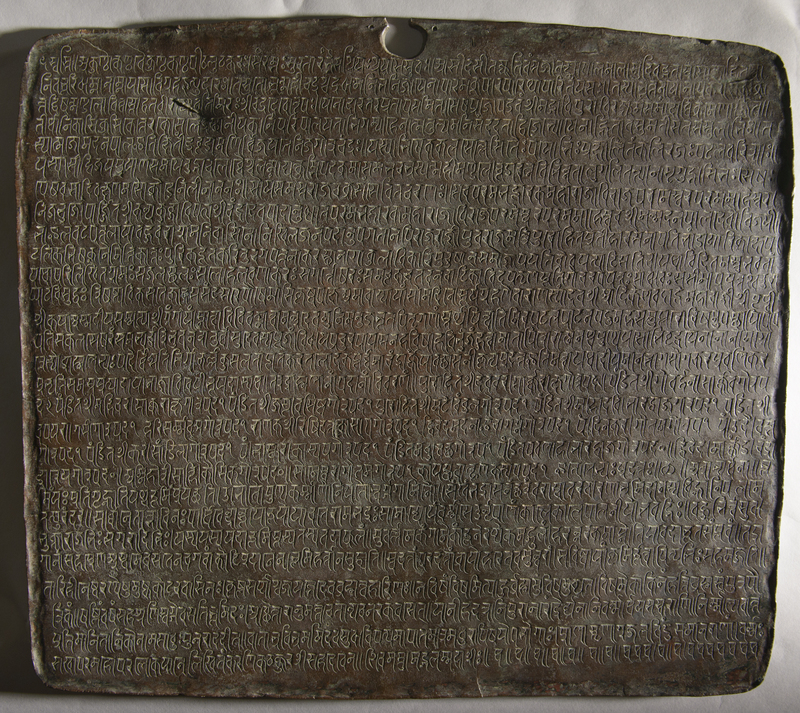
The copperplate is a 12th century royal deed from the reign of Madanapala of Kannauj. It is dated with the year 1163 of the Vikrama era and conveys land to certain specified priests, Brahmins and others
Split tallies were used as a means of recording financial transactions, such as the payment of debts and taxes, from the 12th to the beginning of the 19th century in England. The details of a transaction would be recorded on a single length of wood with a series of cuts of different sizes used to indicate the amount of money involved. The wood was then split with each party taking one part as proof of the transaction; the two parts were known as a stock and a foil. As they fitted together perfectly any tampering of the notches could be detected by reuniting the stock with the foil. These four examples from the Fuller Collection are single parts (stocks), two can be identified as exchequer tallies from 1793, ten years after the use of tallies as Exchequer receipts was abolished but it wasn’t until 1826 that tallies were finally abandoned.
An object from last years of the East India Company’s administration: the 1840 seal of the Governor General of India, Lord Auckland. It is attached to a letter dated 1842 to Maharajah Sher Singh, thanking him for services rendered in relation to the first Afghan war. The letter and the seal are in Persian, which persisted as a lingua franca in the early years of British rule.
Contract tablet of the New Babylonian recording the sale or division of a large quantity of grain, dated in the month of Ab in the 6th year of Nabonidus, King of Babylon