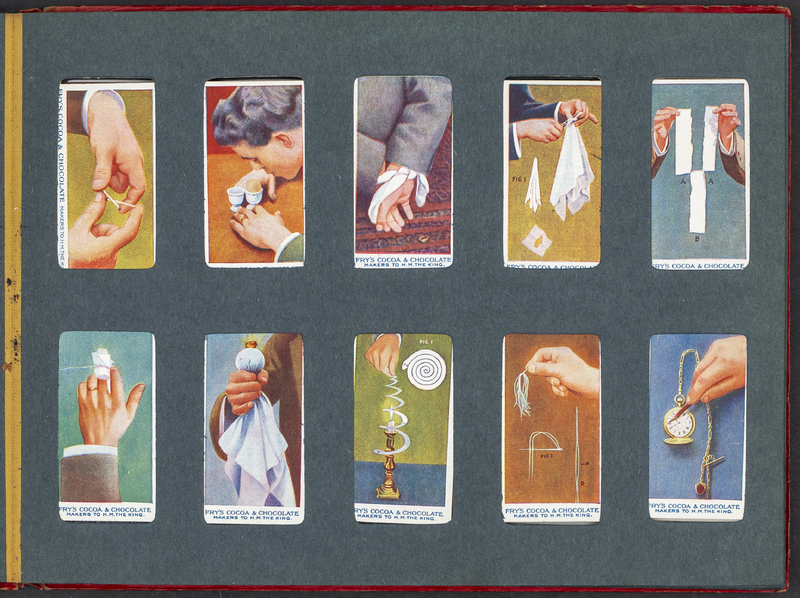
Cigarette cards were a form of trade cards, originally functioning to reinforce cigarette packets but quickly becoming collectable. Companies like confectioner Fry’s produced themed sets like these as promotional tools. Their series of 50 'Amusing tricks and how to do them' feature illustrations with brief descriptions on the reverse.
The Magicians’ Club of London was founded in 1911 by Will Goldston and Harry Houdini, who was elected as its first president. Harry Price initially served as the Club’s Librarian before being elected vice-president on 30 March 1932. The inscription on the back of the medal reads: 'To Harry Price Director of the National Laboratory of Psychical Research London in appreciation of his services to magic from the Council of the Magicians' Club.'
Ira Erastus and William Henry Davenport had a huge influence on 19th century magic and society. From the mid1850s they toured America, and later the world, with their spirit cabinet routine. The Davenports quickly became associated with spiritualism, which was becoming more popular in both America and Britain. The performance was presented as being a genuine supernatural phenomenon. The Davenports’ spirit effects were repeatedly exposed as trickery, but they continued to tour until William Henry’s death in 1877.
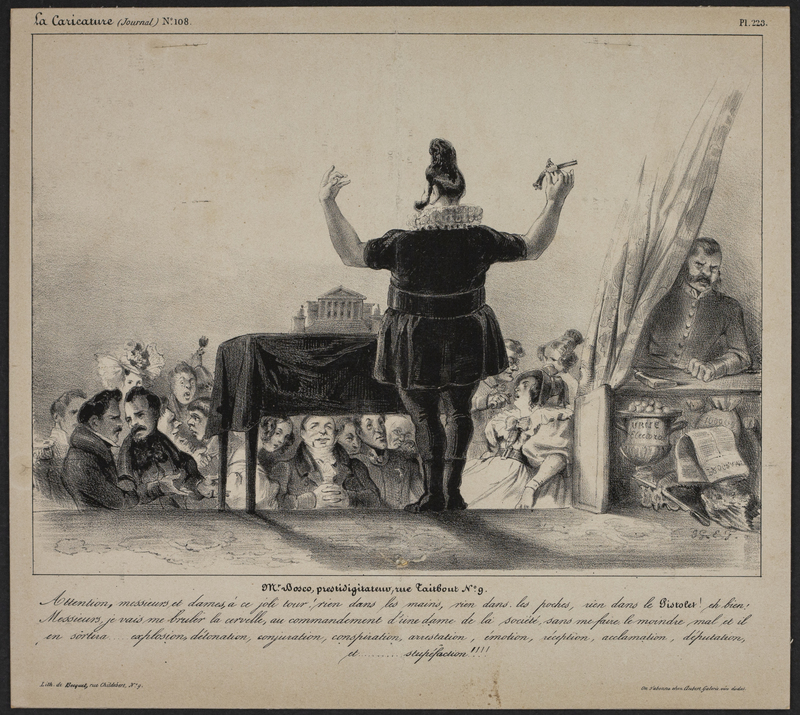
The famous 19th century conjuror Bartolomeo Bosco is alluded to here in a satire on King Louis-Philippe from the French magazine La Caricature. The prestidigitator's patter begins with ‘nothing in the hands, nothing in the pockets, nothing in the pistol’ before offering the audience ‘explosion, detonation, conjuration, conspiracy, arrest, emotion, reception, acclamation, deputation, and… amazement!!!’
This colour lithograph print was part of a series depicting scenes of Paris life in the first half of the 19th century. Here a conjuror performs one of the oldest known acts of sleight of hand, the cups and balls, to a larger audience on the streets of central Paris.
This print was the frontispiece of a pamphlet that would have promoted the Mr Henry’s (John Henry Galbreath) performances. Henry was a Scottish or English performer who had appeared at the Lyceum Theatre and Astley’s Amphitheatre in 1788. He toured a show featuring mechanical amusements, conjuring and ventriloquism. It shows the stage layout of an early 19th century magic show, including draped tables to conceal assistants. Mr. Henry stands at the centre, holding a broken bottle that has just released a live bird.
An enlargement of detail of Isaac Fawkes, an 18th century conjuror, from a print depicting Bartholomew Fair. Fawkes is shown performing the Egg Bag trick, in which a multitude of eggs are produced from an empty bag.
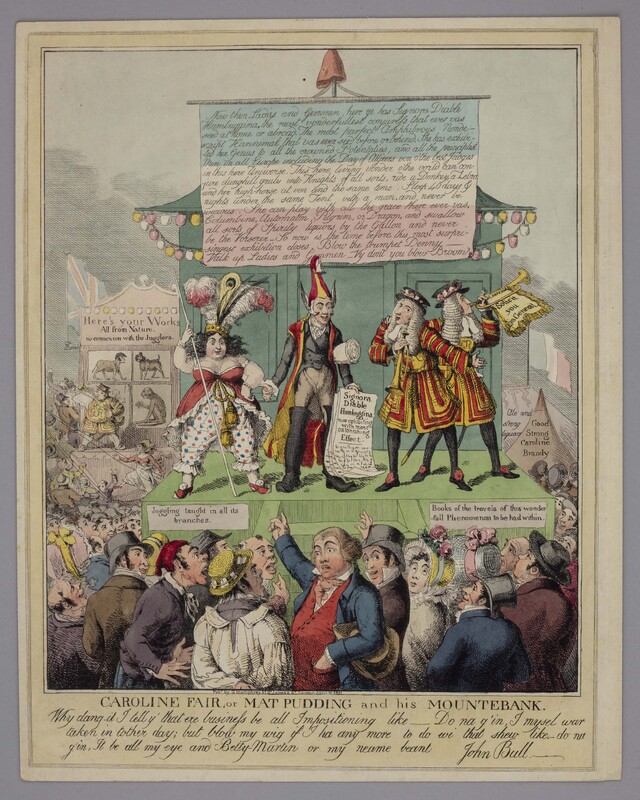
A coloured print of an etching depicting conjuror’s booth at a fair as a satirical attack on Caroline of Brunswick, here taking the role of a conjures with her supporters Henry Brougham and Thomas Denman in attendance as beefeaters.
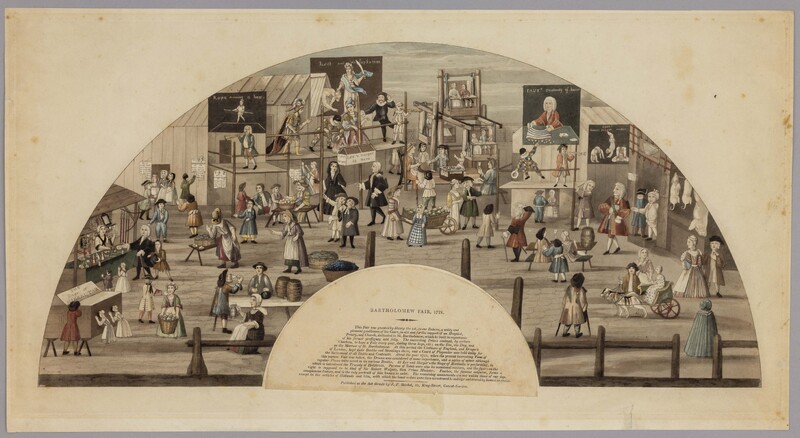
A coloured fan print depicting Bartholomew Fair, one of London’s oldest summer charter fairs, in 1721. Starting in 1133, the annual Fair took place for three days around St Bartholomew’s Day. Its original purpose was as a cloth fair, but it is best known as a pleasure fair, offering its visitors a range of popular entertainments. To the right is the booth of Isaac Fawkes, the most popular conjuror of his day.
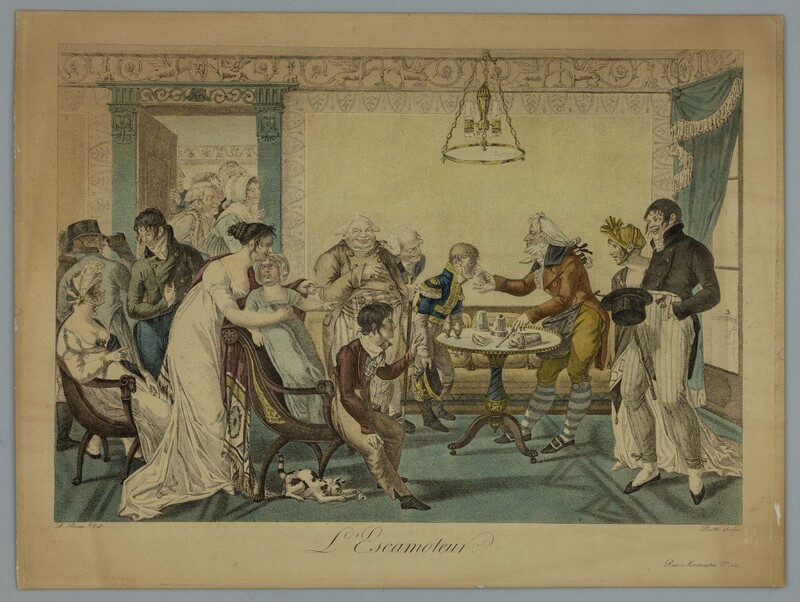
A conjuror performs tricks, including cups and balls, for the amusement of a mixed audience in a salon or parlor. A small animal is included as one of the items emerging from the cups.
Carl Devo was the stage name of Will Goldston, the prolific writer and publisher of guides, biographies, histories and manuals of magic. Goldston began performing at the age of 16 with a ‘black art’ act, as this poster advertises. The act involved using partially black props in front of a black background to create illusions
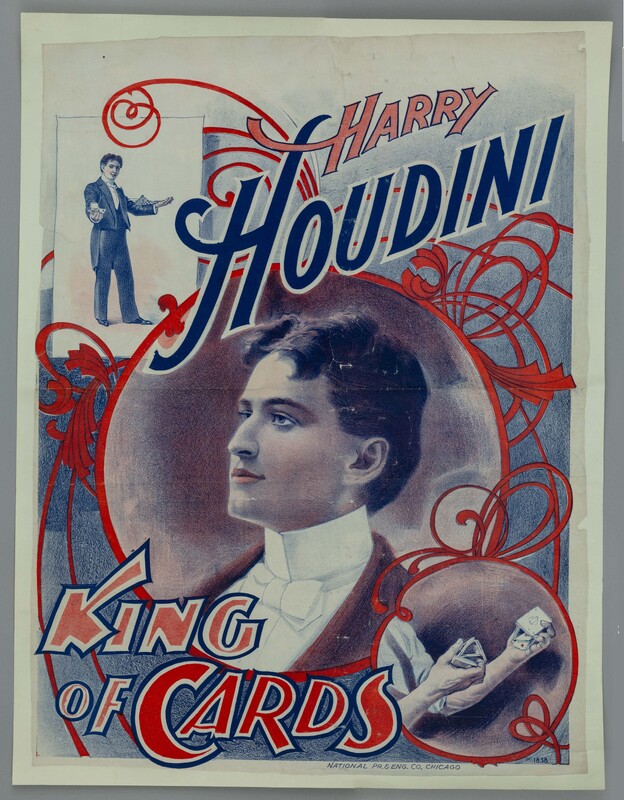
This poster promotes a young Harry Houdini as the ‘King of Cards.’ Houdini’s career began with card magic, but his fame came chiefly from his later performances of feats of escapology and grand stunts, such as making an elephant vanish from the stage of the New York Hippodrome.
This poster advertises a variety bill at the Surrey Theatre, a music hall in south London which started life as a circus in the late 18th century and became a dramatic and variety theatre in the 19th century. The main attraction is the ‘Egyptian’ magician The Great Rameses, the stage name of Polish-British performer Albert Marchinski. He was a specialist in large scale illusions as depicted in the poster.
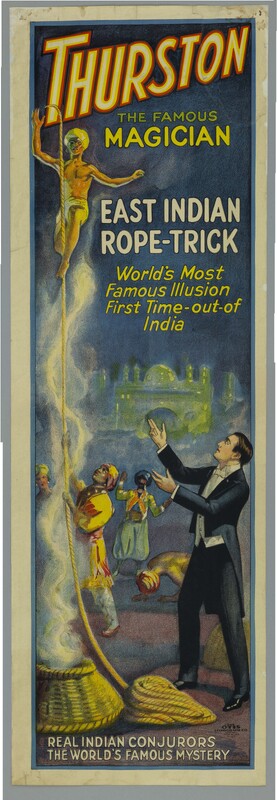
The great American magician Howard Thurston travelled in India in the early 20th century, performing and investigating Indian magic. He never discovered the truth of the legendary Indian Rope Trick, but it was a mainstay of his magic act, which would become one of the biggest touring shows in America. Thurston’s posters are among the most iconic of the golden age of magic, and the typography, design and artwork have come to define the aesthetic of classical conjuring.
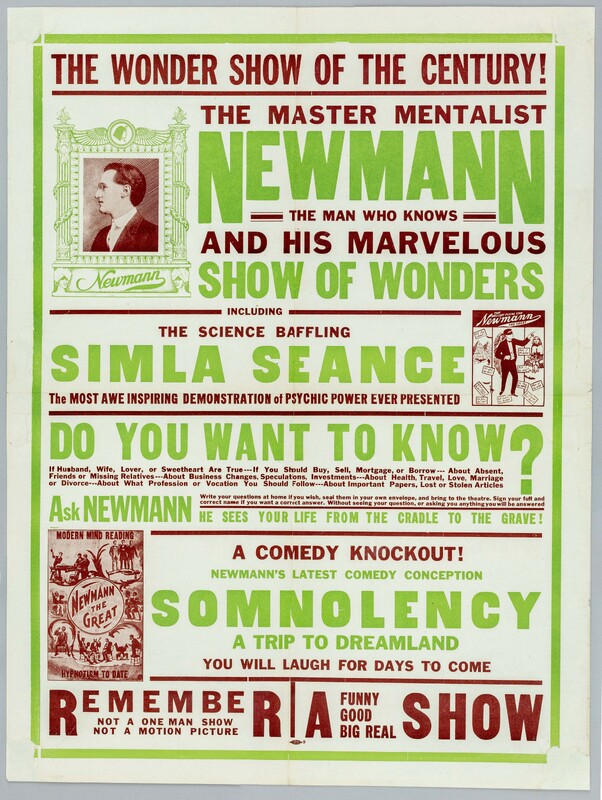
C.A. Newmann, or Newmann the Great was an American stage hypnotist and mentalist whose performances featured highly skilled acts of mind reading and telepathy. Newmann began performing as a teenager in the 1890s and continued to perform until a few years before his death in 1952.