

Aelfredi Regis Res Gestae
- Title
- Aelfredi Regis Res Gestae
- Heading
- Reproducing Old English
- Description
-
Fonts in England in the incunable period were required purely to deal with common languages: English, Latin, law French. Other fonts came much later: when Wynkyn de Worde wanted to print scraps of Greek, Hebrew and Arabic in Robert Wakefield’s Oratio de laudibus trium linguarum (1528), he did so by inserting the words as woodcut blocks. The first book printed in England to use a Greek font was published in 1543 (John Chrysostom’s Tou en hagiois Iōannou tou Chrysostomou homiliai duo); the first to use a Hebrew font in 1656 (Safer tehilim usafer eykhah sepher tehillim u-sepher echam = the Hebrew Text of the Psalmes and Lamentations).
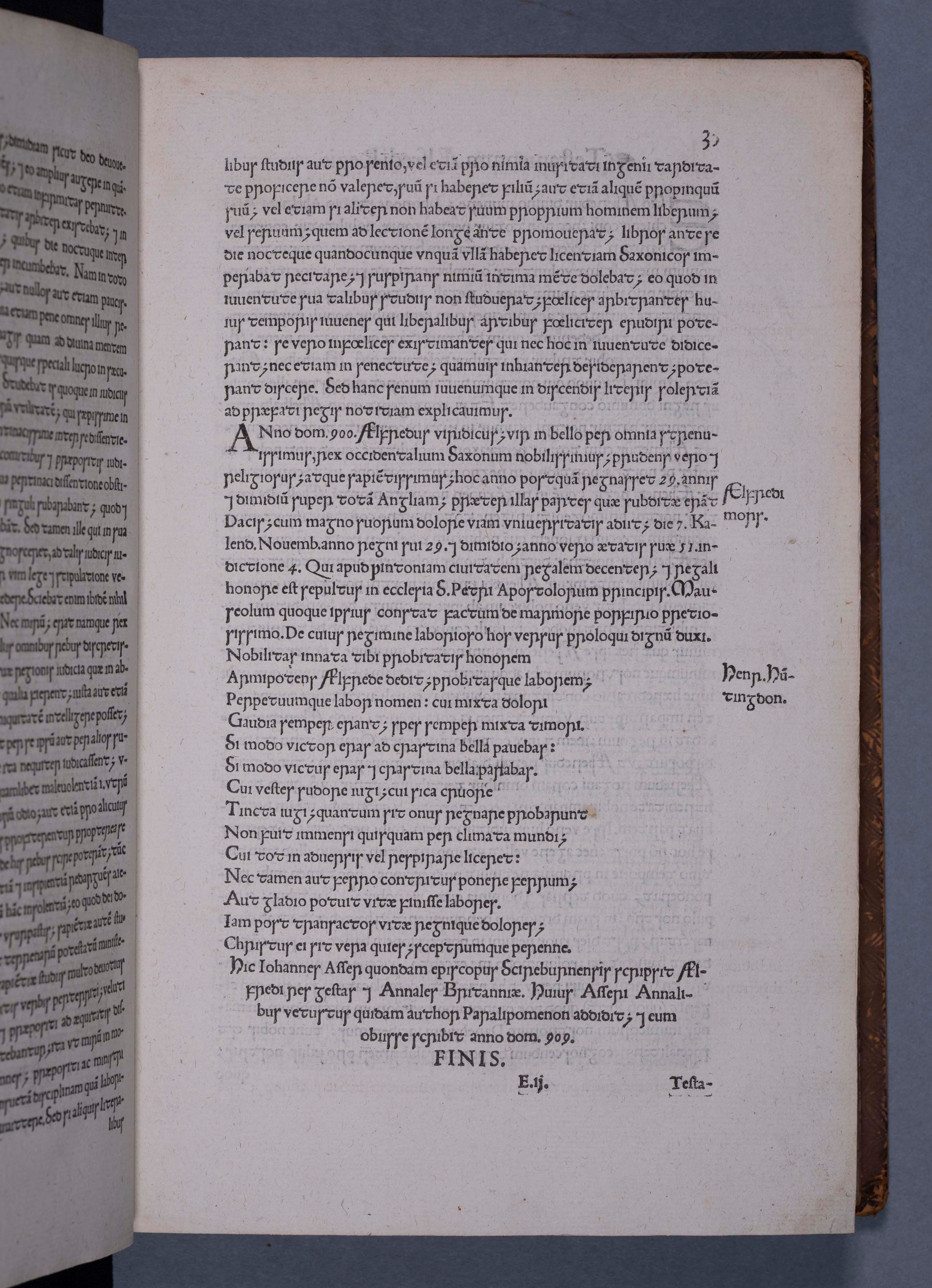
The first text to include an Anglo-Saxon font was published in 1566; this biography of King Alfred by the ninth-century Welsh bishop and scholar John Asser (d. 909) is the third. The font was financed by Matthew Parker, Archbishop of Canterbury. It was designed by Parker’s Latin secretary John Joscelyn (1529-1603) to resemble the writing of Old English manuscripts. It represents antiquity, authority, and authenticity. The desire for an Anglo-Saxon font came about with the English Reformatory zeal to prove the ancientness, and hence validity, of the English church, in an example of print being used for religious propaganda. - Author
- John Asser
- Place of Publication
- London
- Publisher
- John Day
- Date of Publication
- 1574
- Format
- Folio
- Century
- 16th
- Illustrations
- Woodcut