

The Art of Short-Writing according to Tachy-Graphy
- Title
- The Art of Short-Writing according to Tachy-Graphy
- Heading
- Shorthand Limitations
- Description
-
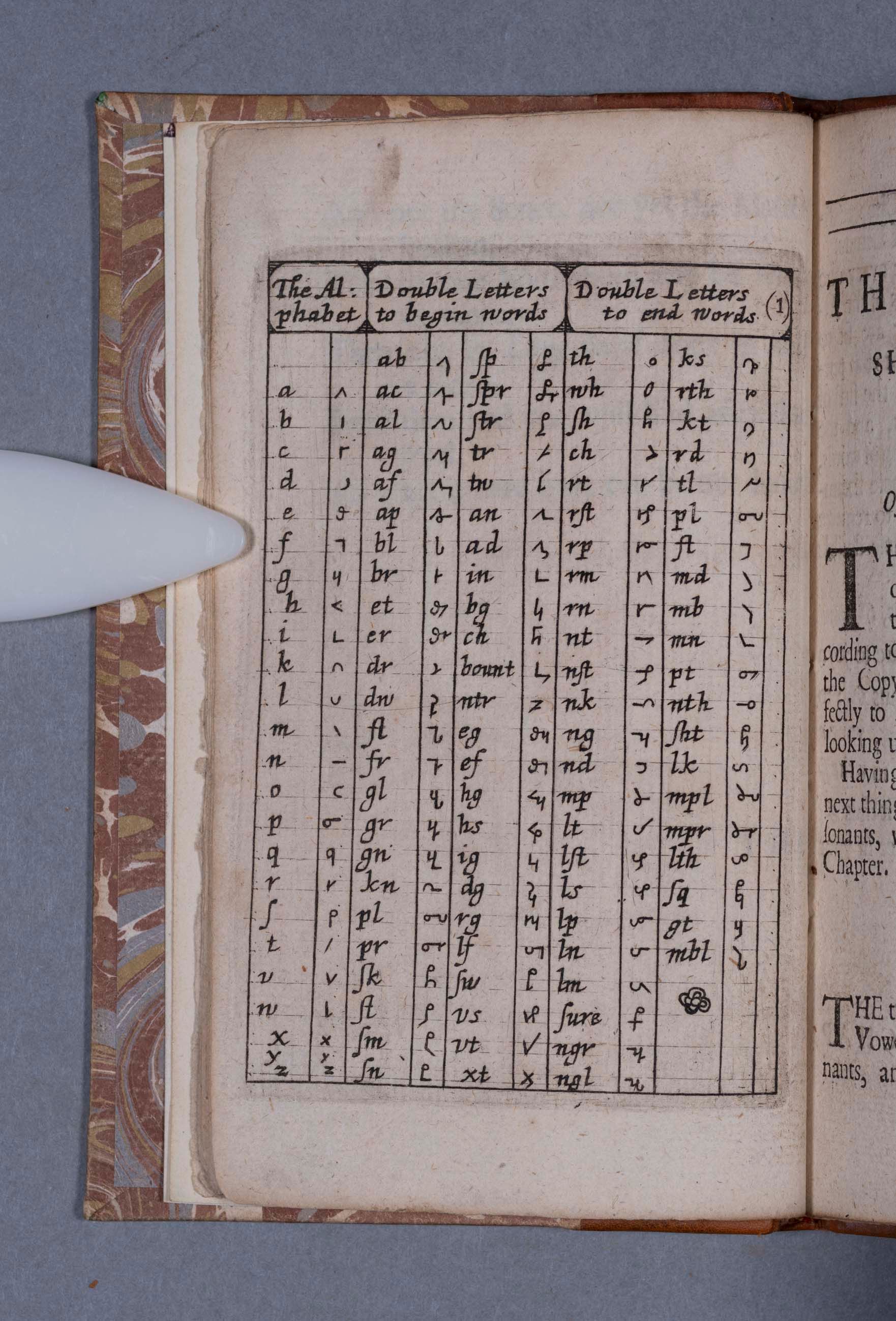
The printing that Caxton practised in England was a simple matter of letters, numerals and woodcuts. Some features not used by Caxton came to England in the sixteenth century, having been used on the Continent in the fifteenth. Other challenges were hard to solve. These included the reproduction of shorthand symbols, a technique which was not mastered until lithography was introduced in the late eighteenth century. Until then, the options to cope with shorthand were either to print books with blank spaces for the symbols to be added by hand, or, as here, to engrave pages.
The book shown is by the seventeenth-century stenographer Thomas Shelton, who taught shorthand in London and created his own system. The first shorthand manual to be printed in England, or anywhere, was Timothie Bright’s Characterie, published by John Windet in 1588. - Author
- Thomas Shelton
- Place of Publication
- London
- Publisher
- W. Whitwood
- Date of Publication
- 1684
- Format
- 8vo
- Century
- 17th
- Illustrations
- Engraving