

The Game of Chess
- Title
- The Game of Chess
- Heading
- “I have purposed to enprynte it”
- Description
-
De ludo scachorum (‘The Game of Chess’) was a popular moral text by the Italian Dominican friar Jacobus de Cessolis (ca 1250-ca 1322). It was a treatise on social classes and the duties of the nobility, in which the chess pieces, their shapes, their positions and their moves represent human society. The work circulated widely in manuscript before making its first printed appearance in Utrecht in 1474. Sixteen Latin and vernacular editions followed in the fifteenth century. Translations were into Italian, German and Dutch as well as English.
William Caxton translated the work into English from two mid-fourteenth-century French translations, by Jean de Vignay and Jean Ferron respectively. His first English edition appeared in Bruges or Ghent in March 1474 and was the first in any language to appear after the Utrecht one. Caxton wrote that the work sold because it was ‘full of wholesome wisdom and requisite unto every state and degree’. It was one of three allegorical works of moral guidance that he published.
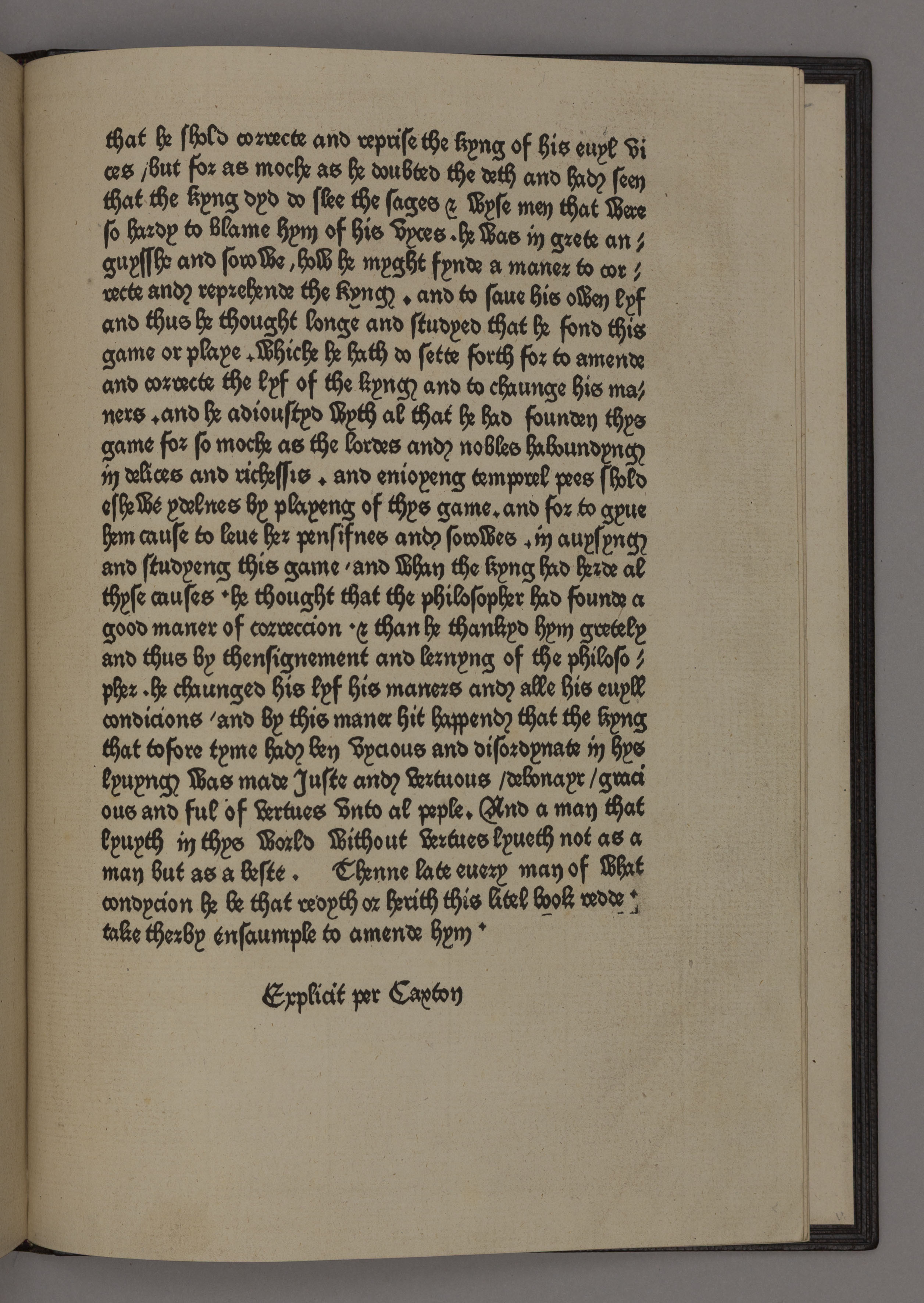
Caxton dedicated his first, unillustrated, edition to George, Duke of Clarence (1449-1478; Edward IV’s brother). Shown here is Caxton’s second edition, from 1483. By then the Duke of Clarence had been imprisoned in the Tower of London for high treason and had died there, so Caxton accordingly excised him from the preface. He also amended the list of contents for greater conformity with chapter headings and added woodcut illustrations - still a novelty in 1483, although Caxton had introduced woodcuts into his books in 1481 in his Mirror of the World. The book contains 24 illustrations, one per chapter, from 16 cuts. Gaps are left for initials to be added by hand.
Senate House Library is one of 14 holding institutions. - Author
- Jacobus de Cessolis
- Place of Publication
- Westminster
- Publisher
- William Caxton
- Date of Publication
- [1483]
- Format
- Folio
- Century
- 15th
- Illustrations
- Woodcut